Resources
Sources and references
Look up the archive references, publication details and editions behind the historical accounts on this website. It lists the sources for particular pages and stories; it is not a complete list of any institution’s holdings.
To read or search published documents, use Letters and documents. To find originals and where they are held, use Find documents worldwide. Each source keeps its own conditions for access and reuse.
Find a source
414 of 414 sources
Family papers and recollections
The family’s journal pages, letters, photographs and later memories.
Bram Stoker’s Dublin journal – manuscript pages and transcriptions
Manuscript page images and reading transcription. Estate manuscript pages: “Night fishing” and “Dreamland”, dated 28 January 1873 on the latter.
Selected pages and provisional readings, not the whole notebook or the complete modern edited text.
The Lost Journal of Bram Stoker – publisher’s description and preview
Published edition preview. Dacre and Elizabeth Miller, editors, The Lost Journal of Bram Stoker: The Dublin Years (2012).
Publisher-supplied description and preview; modern editorial commentary is distinct from the manuscript.
Charlotte Stoker’s letter to Bram about Dracula, 1 June 1897
Manuscript images and reading transcription. Charlotte to Bram, 1 June 1897, first and last surviving pages, Estate images BSE-276 and BSE-273.
Both surviving pages belong to one letter; the provisional transcription labels uncertain readings.
Margaret Stoker (Lady Thomson): family account and photographs
Family account. Estate family recollections and retained photographs.
Family recollection is distinguished from contemporary documentation.
Remembering Noel Thornley Stoker and Neelie – Richard Noel, 1 May 2020
Richard Noel, Memories of Noel Thornley Stoker and Neelie, dated 1 May 2020.
A grandson’s account of family life, education, wartime Seaview and his grandparents. The family called him Noel Thornley Stoker; at work he was NTS.
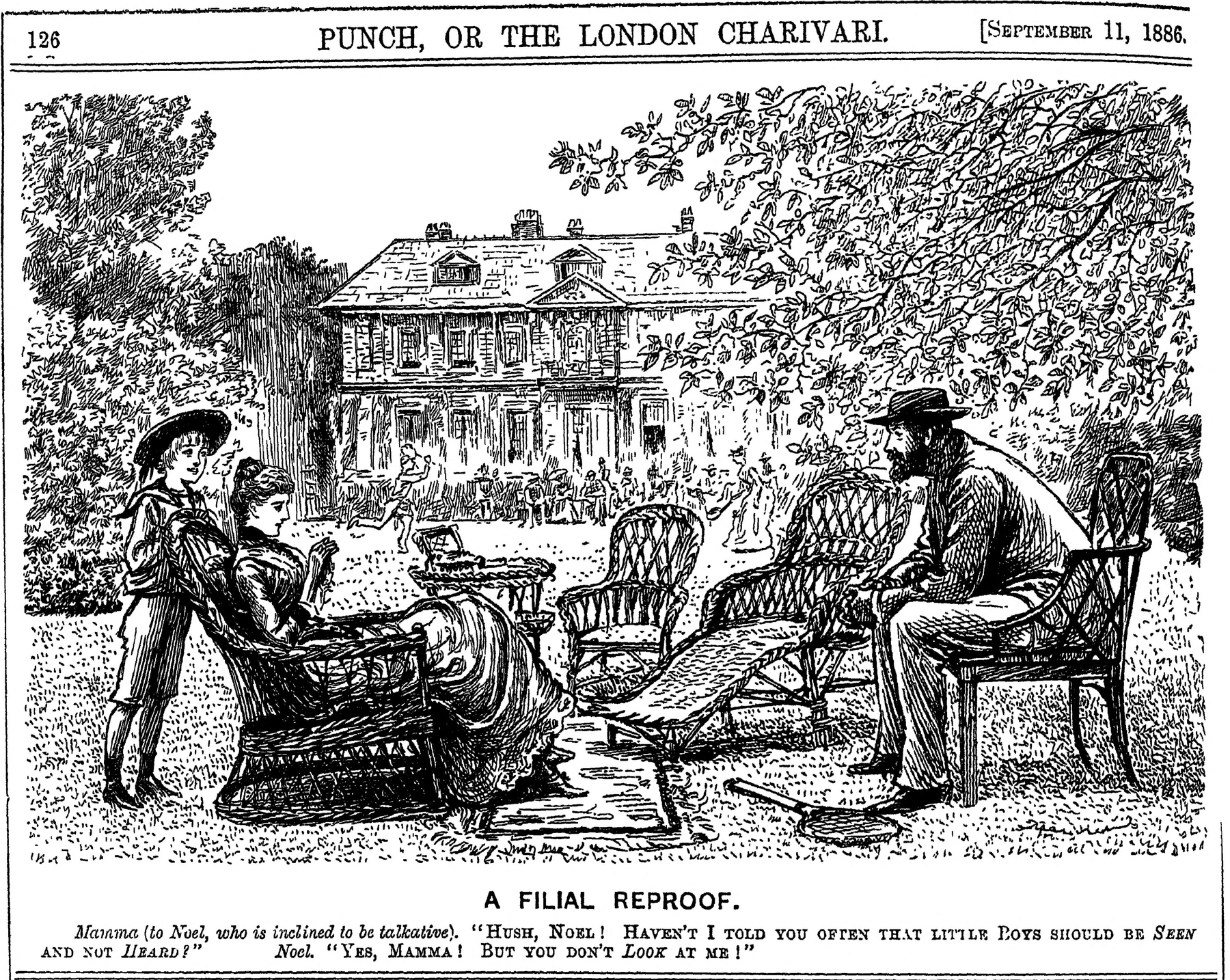
Florence, Bram and Noel in Punch – “A Filial Reproof”, 11 September 1886
Punch, or the London Charivari, volume 91, 11 September 1886, p. 126. “A Filial Reproof” shows a mother telling Noel that little boys should be seen and not heard. He replies, “Yes, Mamma! But you don’t look at me!”
The family identifies the figures as Florence, Bram and their son Noel Stoker. The family’s framed copy and its unchanged photograph are preserved together in the Estate collection; the image below is a separate electronic reproduction of the published page.
Open the complete original page in the Internet Archive.
Francis Cowley Burnand was the editor of the 1886 volumes. The Metropolitan Museum’s record confirms the editor. Bram’s Personal Reminiscences of Henry Irving, volume II, pp. 232–233, records their dinner on 22 October 1882 and states that he knew Burnand well.
Justice of the Raj – Thomas Stoker, complete story
Complete reading transcription (PDF, 7 pages). A story credited to Thomas Stoker, Bram’s brother, who served in the Bengal Civil Service.
The story follows Jenkins, a magistrate travelling with his family, and his dealings with colleagues and local officials. This copy was retained on the Estate’s former website; the original publication date and periodical have not yet been established.
Bram’s writing and the Lyceum
Novels, essays and memoirs, alongside theatre programmes and archive records.
Dracula – Bram Stoker, 1897
Reading edition. Bram Stoker, Dracula (1897), Project Gutenberg eBook 345. Complete novel, including the prefatory statement and final note; the chapter map, theme guide and example essays identify the relevant passages.
Electronic transcription, not an image of a particular family copy.
Read on the Estate website, chapter by chapter · Original transcription at Project Gutenberg · eBook downloads and other formats
The Picture of Dorian Gray – Oscar Wilde, 1891 text
Oscar Wilde, The Picture of Dorian Gray, expanded twenty-chapter book text with the Preface (1891), Project Gutenberg eBook 174. Quotations and chapter references in the comparative example use this version. The thirteen-chapter magazine text appeared in 1890 and differs in wording and structure.
Read the complete twenty-chapter text · Downloads and edition record
The Ethics of Hall Caine – Bram Stoker, Homiletic Review, August 1909
Original journal page scans. The Homiletic Review, August 1909, pp.98–102, The Ethics of Hall Caine.
Complete five-page scan is available at the linked source.
To My Dear Friend Hommy-Beg – Swan River Press edition
Scholarly edition description. To My Dear Friend Hommy-Beg, Swan River Press; contents and publication history.
The 1912 obituary is identified through this edition; its original newspaper scan remains outstanding.
Personal Reminiscences of Henry Irving – Bram Stoker, 1906; revised edition, 1907
Bram Stoker, Personal Reminiscences of Henry Irving, first published in two volumes in October 1906. Project Gutenberg eBook 68779 transcribes the revised one-volume edition of October 1907; its pagination differs from the first edition.
Use the identified edition when citing a page or comparing wording. The free electronic text is distinct from a physical family copy.
Original transcription at Project Gutenberg (revised one-volume edition, 1907) · eBook downloads and other formats
Personal Reminiscences of Henry Irving, volume II, Whitman chapter
The Story of My Life – Ellen Terry, 1908
Reading edition. Ellen Terry, The Story of My Life (1908), passage on George Stoker and her infected thumb. Project Gutenberg 12326.
Terry’s retrospective recollection; a clinical case record has not been identified.
Original transcription at Project Gutenberg · eBook downloads and other formats
Much Ado About Nothing programme – Lyceum Theatre, 25 July 1891
Archive programme record. Much Ado About Nothing, Lyceum Theatre, 25 July 1891, ET-D131a; Ellen Terry and Edith Craig Database, record 7798.
Programme credit identifies Bram as Acting Manager.
Bram Stoker’s theatre business letters, 1891–1903 – Folger Shakespeare Library
Archive correspondence catalogue. Folger Shakespeare Library, record 227056, Stoker’s letters concerning Irving’s business, 1891–1903.
The catalogue confirms the group; it does not supply every complete letter.
Bram Stoker’s letters and Lyceum papers – Shakespeare Birthplace Trust
Archive collection account. Shakespeare Birthplace Trust, Bram Stoker Collection: correspondence and Lyceum ephemera.
Individual documents retain their own archive references; this overview is not a digitised collection.
Bram Stoker’s letter to Walt Whitman, 18 February 1872 – Walt Whitman Archive
Manuscript facsimiles and edited transcription. Walt Whitman Archive, syr.00005; Walt Whitman Collection, Special Collections Research Center, Syracuse University Library.
Five manuscript images accompany the complete edited text. Bram dated this draft 18 February 1872 but kept it until sending it with his covering letter of 14 February 1876.
View the original manuscript images and edited transcription
From the letter
If you care to know who it is that writes this my name is Abraham Stoker (Junior). My friends call me Bram. I live at no 43 Harcourt St Dublin. I am a clerk in the service of the Crown on a small salary. I am twenty four years old. Have been champion at our athletic sports (Trinity College Dublin) and have won about a dozen cups. I have also been President of the College Philosophical Society and an art and theatrical critic of a daily paper. I am six feet two inches high and 12 stone weight naked and used to be 41 or 42 inches round the chest. I am ugly but strong and determined and have a large bump over my eyebrows. I have a heavy jaw and a big mouth with thick lips—sensitive nostrils—a snub nose and straight hair. I am equal in temper and cool in disposition and have a large amount of self control, and am naturally secretive to the world. I take a delight in letting people I don't like—people of mean or cruel or sneaking or cowardly disposition—see the worst side of me. I have a large number of acquaintances and some five or six friends—all of which latter body care much for me. Now I have told you all I know about myself. I know you from your works and your photograph; and if I know anything about you I think you would like to know of the personal appearance of your correspondents. You are I know a keen physiognomist. I am a believer of the science myself and am in an humble way a practicer of it. I was not disappointed when I saw your photograph—your late one in especial.
Read the complete letter here
43 Harcourt St Dublin
Ireland
18-2.72If you are the man I take you to be you will like to get this letter. if you are not I don't care whether you like it or not, and only ask you to put it into the fire without reading any farther. But I believe you will like it. I dont think there is a man living, even you who are above the prejudices of the class of small-minded men—who wouldn't like to get a letter from a younger man, a stranger from across the world—a man living in an atmosphere prejudiced to the truths you sing and your manner of singing them. The idea that arises in my mind is whether there is a man living who would have the pluck to burn a letter in which he felt the smallest atom of interest without reading it. I believe you would and that you believe you would yourself—You can burn this now if you like and test yourself and all I will ask for my trouble of writing this letter, which for all I can tell you may light your pipe with or apply to some more ignoble purpose—is that you will in some manner let me know that my words have tested your impatience. Put it in the fire if you like—but if you do you will miss the pleasure of this next sentence which ought to be that you have conquered an unworthy impulse. A man who is uncertain of his own strength might try to encourage himself by a piece of bravo, but a man who can write, as you have written, the most candid words that ever fell from the lips of mortal man can have no fear for his own strength.—a man to whose candour Rousseau's Confessions is reticence—can have no fear for his own strength. If you have gone this far you may read the letter and I feel in writing now that I am talking to you. If I were before your face I would like to shake hands with you for I feel that I would like you—I would like to call you Comrade and to talk to you as men who are not poets do not often talk.
I think that at first I would be ashamed for a man cannot in a moment break the habit of comparative reticence that has become a second nature to him; but I know I would not be long ashamed to be natural before you. You are a true man and I would like to be one myself and so I would feel towards you as a brother and as a pupil to his master. In this age no man becomes worthy of the name without an effort. You have shaken off the shackles and your wings are free. I have the shackles on my shoulders still.—but I have no wings. If you are going to read this letter any further I should tell you that I am not prepared to "give up all else" so far as words go. The only thing I am prepared to give up is prejudice—and before I knew you I had begun to throw overboard my cargo—but it is not all gone yet. I do not know how you will take this letter. I have not adressed you in any form as I have heard that you dislike to a certain degree the conventional forms in letters. I am writing to you because you are different from other men. if you were the same as the mass I would not write at all as it is I must either call you Walt Whitman or not call you at all—and I have chosen the latter course. I do not know if it is usual for you to get letters from utter strangers who have not even the claim of literary brotherhood to write to you—if it is you must be frightfully tormented with letters and I am sorry to have written this. I have however the claim of liking you—for your words are your own soul and even if you do not read my letter it is no less a pleasure to me to write it. Shelley wrote to William Godwin and they became friends. I am not Shelley and you are not Godwin & so I will only hope that some time I may meet you face to face and perhaps shake hands with you—If I ever do it will be one of the greatest pleasures of my life.
If you care to know who it is that writes this my name is Abraham Stoker (Junior). My friends call me Bram. I live at no 43 Harcourt St Dublin. I am a clerk in the service of the Crown on a small salary. I am twenty four years old. Have been champion at our athletic sports (Trinity College Dublin) and have won about a dozen cups. I have also been President of the College Philosophical Society and an art and theatrical critic of a daily paper. I am six feet two inches high and 12 stone weight naked and used to be 41 or 42 inches round the chest. I am ugly but strong and determined and have a large bump over my eyebrows. I have a heavy jaw and a big mouth with thick lips—sensitive nostrils—a snub nose and straight hair. I am equal in temper and cool in disposition and have a large amount of self control, and am naturally secretive to the world. I take a delight in letting people I don't like—people of mean or cruel or sneaking or cowardly disposition—see the worst side of me. I have a large number of acquaintances and some five or six friends—all of which latter body care much for me. Now I have told you all I know about myself. I know you from your works and your photograph; and if I know anything about you I think you would like to know of the personal appearance of your correspondents. You are I know a keen physiognomist. I am a believer of the science myself and am in an humble way a practicer of it. I was not disappointed when I saw your photograph—your late one in especial.
The way I came to like you was this. A notice of your poems appeared some two years ago or more in the "Temple Bar" magazine. I glanced at it and took its dictum as final, and laughed at you among my friends. I say it to my own shame but not to my regret for it has taught me a lesson to last my life out—without ever having seen your poems. More than a year after I heard two men in College talking of you, one of them had your book (Rossetti's Edition) and was reading aloud some passages at which both laughed. They chose only those passages which are most foreign to British ears and made fun of them. Something struck me that I had judged you hastily. I took home the volume and read it far into the night. Since then I have to thank you for many happy hours, for I have read your poems with my door locked late at night, and I have read them on the sea shore where I could look all round me and see no more sign of human life than the ships out at sea: and here I often found myself waking up from a reverie with the book lying open before me. I love all poetry and high generous thoughts make the tears rush to my eyes—but sometimes a word or a phrase of yours takes me away from the world around me and places me in an ideal land surrounded by realities more than any poem I ever read. Last year I was sitting on the beach on a summer's day reading your preface to the Leaves of Grass as printed in Rossetti's Edt., for Rossetti is all I have got till I get the complete set of your works which I have ordered from America). One thought struck me and I pondered over it for several hours—"the weather-beaten vessels old ships entering new ports" you who wrote the words know them better than I do: and to you who sing of your own land of Progress the words have a meaning that I can only imagine. But be assured of this Walt Whitman that a man of less than half your own age reared a conservative in a conservative country and who has always heard your name cried down by the great mass of people who mention it here felt his heart leap towards you across the Atlantic, and his soul swelling at the words or rather the thoughts. It is vain for me to try to quote any instances of what thoughts of yours I like best, for I like them all and you must feel that you are reading the true words of one who feels with you.
You see I have called you by your name I have been more candid with you—have said more about myself to you than I have ever said to any one before—You will not be angry with me now if you have read so far you will not laugh at me for writing thus to you. It was with no small effort that I began to write and I feel reluctant to stop, but I must not tire you any more. If you ever would care to have more you can imagine, for you have a great heart, how much pleasure it would be to me to write more to you, how sweet a thing it is for a strong healthy man with a woman's eyes and a child's wishes to feel that he can speak so to a man who can be if he wishes father and brother and wife to his soul. I don't think you will laugh Walt Whitman, nor despise me, but at all events I thank you for all the love and sympathy you have given me in common with my kind.
Bram Stoker
Reading transcription: original wording and spelling retained; manuscript line breaks are joined and editorial markers omitted.
Text checked against The Walt Whitman Archive, general editors Matt Cohen, Ed Folsom and Kenneth M. Price, “Abraham Stoker to Walt Whitman, 18 February 1872”, syr.00005. Walt Whitman Collection, Special Collections Research Center, Syracuse University Library. Contributors to the archive digital file: Alex Kinnaman, Elizabeth Lorang, Kathryn Kruger, John Schwaninger, Nima Najafi Kianfar, Caterina Bernardini, Marie Ernster, Cristin Noonan, Paige Wilkinson, Stephanie Blalock and Amanda J. Axley.
Read all three letters together · Download the reading text (.txt)
Bram Stoker’s covering letter to Walt Whitman, 14 February 1876 – Walt Whitman Archive
Manuscript facsimiles and edited transcription. Walt Whitman Archive, loc.01945; Charles E. Feinberg Collection of the Papers of Walt Whitman, Library of Congress.
Four manuscript images accompany the complete edited text. The letter explains that Bram’s earlier draft had remained in his desk for four years.
View the original manuscript images and edited transcription
From the letter
I hope you will not consider this letter from an utter stranger a liberty. Indeed, I hardly feel a stranger to you, nor is this the first letter that I have written to you. My friend Edward Dowden has told me often that you like new acquaintances or I should rather say friends. And as an old friend I send you an inclosure which may interest you. Four years ago I wrote the enclosed draft of a letter which I intended to copy out and send to you—it has lain in my desk since then—when I had heard that you were addressed as Mr. Whitman. It speaks for itself and needs no comment. It is as truly what I wanted to say as that light is light. The four years which have elapsed have made me love your work four fold and I can truly say that I have ever spoken as your friend.
Read the complete letter here
119 Lower Baggot Street
Dublin
14 February 1876My dear Mr. Whitman,
I hope you will not consider this letter from an utter stranger a liberty. Indeed, I hardly feel a stranger to you, nor is this the first letter that I have written to you. My friend Edward Dowden has told me often that you like new acquaintances or I should rather say friends. And as an old friend I send you an inclosure which may interest you. Four years ago I wrote the enclosed draft of a letter which I intended to copy out and send to you—it has lain in my desk since then—when I had heard that you were addressed as Mr. Whitman. It speaks for itself and needs no comment. It is as truly what I wanted to say as that light is light. The four years which have elapsed have made me love your work four fold and I can truly say that I have ever spoken as your friend.
You know what hostile criticism your work sometimes evokes here, and I wage a perpetual war with many friends on your behalf. But I am glad to say that I have been the means of making your work known to many who were scoffers at first. The years which have passed have not been uneventful to me, and I have felt and thought and suffered much in them, and I can truly say that from you I have had much pleasure and much consolation—and I do believe that your open earnest speech has not been thrown away on me or that my life & thoughts fail to be marked with its impress—I write thus openly because I feel that with you one must be open. We have just had tonight a hot debate on your genius at the Fortnightly Club in which I had the privilege of putting forward my views—I think with success. Do not think me "cheeky" for writing thus. I only hope we may sometime meet & I shall be able perhaps to say what I cannot write. Dowden promised to get me a copy of your new edition—and I hope that for any other work which you may have you will let me always be an early subscriber. I am sorry that you are not strong. Many of us were hoping to see you in Ireland.
We had arranged to have a meeting for you—I do not know if you like getting letters. If you do I shall only be too happy to send you news of how thought goes among the men I know—
With truest wishes for your health and happiness believe me
Your friend
Bram Stoker
Reading transcription: original wording and spelling retained; manuscript line breaks are joined and editorial markers omitted.
Text checked against The Walt Whitman Archive, general editors Matt Cohen, Ed Folsom and Kenneth M. Price, “Abraham Stoker to Walt Whitman, 14 February 1876”, loc.01945. Charles E. Feinberg Collection of the Papers of Walt Whitman, Library of Congress. Contributors to the archive digital file: Alex Kinnaman, Elizabeth Lorang, Ashley Lawson, John Schwaninger, Eder Jaramillo, Caterina Bernardini, Marie Ernster, Paige Wilkinson, Amanda J. Axley and Stephanie Blalock.
Read all three letters together · Download the reading text (.txt)
Walt Whitman’s reply to Bram Stoker, 6 March 1876 – Walt Whitman Archive
Complete published letter transcription. Walt Whitman Archive, uva.00372; manuscript reference: Papers of Walt Whitman, MSS 3829, University of Virginia.
The archive derives its reading text from Walt Whitman, The Correspondence, edited by Edwin Haviland Miller (New York University Press, 1964), p. 28. This entry supplies a transcription, not an autograph image.
Read the archive’s edited transcription
From the letter
Your letters have been most welcome to me—welcome to me as Person, & then as Author—I don't know which most—You did well to write to me so unconventionally, so fresh, so manly, & so affectionately too. I too hope (though it is not probable) that we shall one day personally meet each other. Meantime I send you my friendship & thanks.
Read the complete letter here
431 Stevens st.
cor West.
Camden, N. Jersey, U. S. America.
March 6
76'Bram Stoker,
My dear young man,Your letters have been most welcome to me—welcome to me as Person, & then as Author—I don't know which most—You did well to write to me so unconventionally, so fresh, so manly, & so affectionately too. I too hope (though it is not probable) that we shall one day personally meet each other. Meantime I send you my friendship & thanks.
Edward Dowden's letter containing among others your subscription for a copy of my new edition, has just been rec'd. I shall send the books very soon by express in a package to his address. I have just written to E. D.
My physique is entirely shatter'd—doubtless permanently—from paralysis & other ailments. But I am up & dress'd, & get out every day a little—live here quite lonesome, but hearty, & good spirits.
Write to me again.
Walt Whitman
Reading transcription: original wording and spelling retained; manuscript line breaks are joined and editorial markers omitted.
Read all three letters together · Download the reading text (.txt)
Arthur Conan Doyle’s letter to Bram Stoker, 20 August 1897 – published transcription
An external reading page or reference supplied by the named source. Its publication details and any access or reuse conditions remain with the provider.
Pamela Colman Smith and the Lyceum tour – National Trust Collections reference
National Trust Collections reference 1122457.8, associated with Pamela Colman Smith and the Lyceum tour. The former item link currently leads to a notice that the collections website is being migrated; the complete object description and image cannot presently be checked there.
The Business Manager at Irving’s Lyceum – Audrey Anne Keith McIntosh, M.Litt thesis, 1991
Complete digitised thesis. Audrey Anne Keith McIntosh, The Business Manager at Irving’s Lyceum, M.Litt thesis, University of Glasgow, September 1991.
The university supplies the complete 327-page PDF, including preliminary matter and illustrations. The author retains copyright; the repository permits personal non-commercial research or study.
Ellen Terry and Edith Craig – programme and correspondence catalogue
A repository catalogue, institutional reference or research guide. A catalogue description is distinct from a scan of the underlying document.
Henry Irving research resources – The Irving Society
A repository catalogue, institutional reference or research guide. A catalogue description is distinct from a scan of the underlying document.
Henry Irving and Bram Stoker: A Working Relationship – Michael Kilgarriff
Scholarly essay, 9-page PDF. Michael Kilgarriff examines the partnership between Irving and Stoker, their contrasting characters and the work that sustained Irving’s theatrical career. His assessment of their personal relationship is an interpretation, to be read alongside Bram’s memoir and the surviving correspondence.
Read the Irving Society essay through the Internet Archive (PDF). The archived copy preserves the author’s name as Michael Kilgarriff; the former Estate website omitted the second “r”.
The Internet Archive captured this PDF on 30 May 2015. That is the archive capture date, not an established publication date. The original Irving Society address currently restricts access; the archived reading copy is linked here rather than republished.
The American Audience – Bram Stoker, April 1885 reprint
An online reading edition. Follow the source for its transcription, language, edition details and reuse terms.
Bram Stoker’s works – Project Gutenberg catalogue
An online reading edition. Follow the source for its transcription, language, edition details and reuse terms.
The Fate of Fenella – collaborative novel, Project Gutenberg edition
An online reading edition. Follow the source for its transcription, language, edition details and reuse terms.
Drakula – early Hungarian edition, Project Gutenberg
An online reading edition. Follow the source for its transcription, language, edition details and reuse terms.
Dracula: research text and editorial record – CELT, University College Cork
A repository catalogue, institutional reference or research guide. A catalogue description is distinct from a scan of the underlying document.
Arthur Conan Doyle’s career and work – Bram Stoker interview transcription
An external reading page or reference supplied by the named source. Its publication details and any access or reuse conditions remain with the provider.
Arthur Conan Doyle interview – The World, original American publication
A complete supplied page scan of Bram Stoker’s illustrated interview with Arthur Conan Doyle in The World, New York, 28 July 1907. The headline also mentions America and Doyle’s approaching marriage. A source image, distinct from the linked reading transcription.
Arthur Conan Doyle interview – Daily Chronicle, British publication
The illustrated British version of Bram Stoker’s Arthur Conan Doyle interview, Daily Chronicle, 14 February 1908, p. 8. A complete supplied page scan is available. It is a distinct newspaper version from the American publication of 28 July 1907.
W. S. Gilbert and the modern stage – Bram Stoker interview, published transcription
Bram Stoker, “The Tendency of the Modern Stage: A Talk with Sir W. S. Gilbert on Things Theatrical”, Daily Chronicle, 2 January 1908, p. 8. GSArchive provides Arthur Robinson’s complete reading transcription. Its source note identifies a New York World appearance in 1907 as apparent rather than confirmed; this is not an original newspaper scan.
W. S. Gilbert interview report – Auckland Star, 22 February 1908, Papers Past
A contemporary report of Bram Stoker’s interview with W. S. Gilbert, in the opening paragraph of “News, Views, and Opinions”, Auckland Star, 22 February 1908, p. 11. Papers Past supplies the newspaper images and searchable OCR; the OCR may contain errors. This report is distinct from the full original interview.
Henry Irving’s Fight for Fame – Bram Stoker, Success Magazine, February 1906
Bram Stoker, “Henry Irving’s Fight for Fame”, Success Magazine, February 1906, pp. 87–88 and 126. The original byline identifies him as Irving’s personal representative since 1878. The article continues on p. 126, where it concludes.
The original source pages are available below. The Estate reading version has not been fully collated line by line against these scans.
Read the original issue: opening on p. 87 · Read the continuation on p. 126
The Great White Fair in Dublin – Bram Stoker, The World’s Work, May 1907
Bram Stoker, “The Great White Fair in Dublin”, The World’s Work, May 1907, pp. 570–576. The complete seven-page scan includes the illustrated pages; on p. 576 Stoker’s article ends before Frank Bonnett’s separate “An Exhibition in the Making”.
The original source pages are available below. The Estate reading version has not been fully collated line by line against these scans.
The World’s Greatest Shipbuilding Yard – Bram Stoker, The World’s Work, May 1907
Bram Stoker, “The World’s Greatest Ship-Building Yard”, The World’s Work, May 1907, pp. 647–650. The complete four-page scan includes the photographs and illustration-only p. 648.
The original source pages are available below. The Estate reading version has not been fully collated line by line against these scans.
Winston Churchill interview – Bram Stoker, New York World, 5 October 1907
Source: New York World, 5 October 1907; Daily Chronicle, London, 15 January 1908.
The American interview was published in The World, New York, on 5 October 1907. A scan of that original issue has not been recovered here. Available scans show the Evansville Courier reprint of 6 October 1907 and the Daily Chronicle version of 15 January 1908; these versions should be distinguished.
Read the Evansville Courier reprint · Read the British version
Winston Churchill interview – Daily Chronicle, 15 January 1908
“Mr. Winston Churchill: Talks of His Hopes, His Work, and His Ideals to Bram Stoker”, Daily Chronicle, 15 January 1908. A complete scan of this illustrated British newspaper version is available.
The original source pages are available below. The Estate reading version has not been fully collated line by line against these scans.
Read the Daily Chronicle page · Read the Evansville Courier reprint, 6 October 1907
Americans as Actors – Bram Stoker, Fortnightly Review, 1 February 1909
Bram Stoker, “Americans as Actors”, Fortnightly Review, 1 February 1909, pp. 243–252. A complete ten-page scan is available; the printed volume number is LXXXV in the new series (91 in the general-series bibliography).
The original source pages are available below. The Estate reading version has not been fully collated line by line against these scans.
Contemporary review of Personal Reminiscences of Henry Irving – The Theatre, December 1906
“New Dramatic Books”: review of Bram Stoker’s Personal Reminiscences of Henry Irving, The Theatre Magazine, December 1906, vol. VI, no. 70, advertiser pp. iv and vii. The complete review runs from the right-hand column on p. iv to the left-hand column on p. vii.
Both original review pages have been checked. Internet Archive provides the complete issue and searchable OCR; its scan notice warns that tight binding cuts off some text.
“Sir Henry Irving” – Max Montesole, The West Australian, 17 November 1934
Max Montesole, “Little Memories of Big People: XIV.—Sir Henry Irving”, The West Australian, 17 November 1934, p. 5. Trove supplies the complete newspaper article and searchable OCR. Montesole’s recollections are an attributed personal account; the Estate reading page contains selected passages.
The original newspaper record and complete searchable text have been verified. OCR errors remain; the article has not been manually transcribed in full.
Collection Connections: Shadowplay by Joseph O’Connor – Folger Shakespeare Library
Folger Shakespeare Library’s discussion of Joseph O’Connor’s Shadowplay and related collection material. Literary discussion and archival evidence should be distinguished.
Dracula Stalks the Strand – Kathleen Lynch-Howard, Strandlines, 11 October 2020
Kathleen Lynch-Howard, “Dracula Stalks the Strand”, Strandlines,11 October 2020. Referenced for the Irving, Stoker and Terry names on the Burleigh Street wall of the Lyceum; the article’s wider historical claims are not adopted here.
The Censorship of Fiction – Bram Stoker, September 1908
Bram Stoker, “The Censorship of Fiction”, The Nineteenth Century and After, September 1908. The English essay is reprinted in REEL 8.10 (2012).
This later reprint should be distinguished from the original journal pages.
Hamilton Deane’s Dracula, 1925–1939 – Cadbury Research Library, MS38/1918
University of Birmingham, Cadbury Research Library, theatre collection: Dracula by Hamilton Deane, finding number MS38/1918. Production records give the London transfers in 1927, the Broadway opening and the Winter Garden and Lyceum revival in 1939.
The record describes cuttings and typed cast lists, not a complete online facsimile. XMS38/988 is the record’s URL identifier; the displayed finding number is MS38/1918.
Family lives and public work
Biographies and sources for education, charitable work and medicine.
Education for deaf children – Charlotte Stoker’s paper, 1863
Reading transcription. Charlotte Stoker, paper read 13 May 1863, On the Necessity of a State Provision for the Education of the Deaf and Dumb of Ireland.
Historical title retained. Transcript cites pp.456–458; catalogue pagination differs and needs collation.
Download the paper and subsequent discussion (PDF, 5 pages). This reading transcription was preserved on the former Estate website. Charlotte’s paper agrees in wording with the linked reading text apart from minor transcription differences; the PDF also contains the reported discussion, including a contribution by Dr W. E. Wilde. Its five modern pages do not represent the original printed pagination.
Charlotte Stoker’s cholera memoir: a historian’s account – Marion McGarry
Manuscript context and extracts. Charlotte Stoker’s recollection, 1873; Trinity College Dublin, Stoker Family Papers, MS 11076/2/3. Marion McGarry, Irish Humanities Alliance.
The linked article discusses the manuscript; it is not a complete autograph scan.
Sir William Thornley Stoker: a biography – Carmel Doyle, Dictionary of Irish Biography
Scholarly biography. Carmel Doyle, Dictionary of Irish Biography, entry a8325.
Named career dates are used; no claim that he originated a fictional character.
Read Carmel Doyle’s complete biography at the Dictionary of Irish Biography
William Thomson’s life and career – Dictionary of National Biography, 1912
Historical biographical transcription. 1912 supplement; William Thomson (1843–1909). Honours and Irish Hospital service.
No original page image is offered here.
Margaret’s charitable work – The Story of the Mageough, 2021
Later institutional history quoting a contemporary report. The Story of the Mageough (2021), passage quoting The Lancet, March 1907.
The original Lancet issue and page remain to be identified.
Open later institutional history quoting a contemporary report
Anatomy Room Gallery catalogue – Royal College of Surgeons in Ireland
Institutional collection catalogue. RCSI Anatomy Room Gallery catalogue, Thornley Stoker entry.
Modern catalogue and images remain with RCSI.
With “the Unspeakables” – George Stoker, 1878
Digitised book and library catalogue. George Stoker, With “the Unspeakables”; or, Two Years’ Campaigning in European and Asiatic Turkey (London: Chapman and Hall, 1878), OCLC 801455971.
The Internet Archive copy includes the original title page and the text through its final printed page, 125. The downloadable PDF contains 144 scanned pages, including preliminary matter and blanks. Its machine-generated OCR has not been corrected.
Read the complete scan at the Internet Archive · Download the scanned PDF from the Internet Archive
The Economy of the Treatment of Wounds and Ulcers by Oxygen Gas – George Stoker, BMJ, 2 May 1896
Original medical journal article. George Stoker, The Economy of the Treatment of Wounds and Ulcers by Oxygen Gas, British Medical Journal, 2 May 1896, pp.1087–1088.
Two distinct publications appeared in 1896. This entry identifies the May BMJ paper; the July article in The Hospital is a separate source.
Read the original journal pages at PubMed Central – pages 1087–1088. The article begins in the lower right column of page 1087 and concludes in the left column of page 1088.
An Improved Inhaling Apparatus – George Stoker, Medical Press and Circular, 2 April 1884
Reading transcription and illustration retained from the former Estate website. The former page attributes the notice to the Medical Press and Circular, 2 April 1884. The original journal page and pagination have not yet been independently verified.
The notice describes a vapour inhaler with a flexible cover, glass mouthpiece and air tube. It could be fitted to an ordinary cup, jug or jar, avoiding the need for a separate reservoir, and was advertised at two shillings.
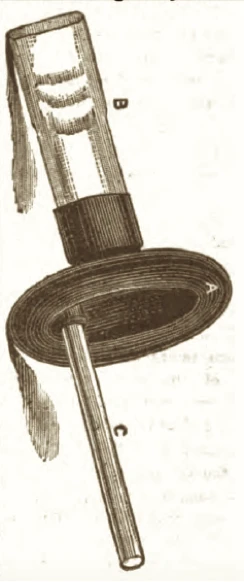
A new, economical, and effective form of vapour inhaler has been designed by Dr. George Stoker of London.
The invention consists of a flexible cover (A), fitted with glass mouthpiece (B) and air tube (C), to carry the air through the medicated fluid. The ease with which it can be attached to various household vessels, such as a cup, jug, or jar, obviates the necessity of purchasing the reservoir used with most inhalers. Its portability and cheapness (being sold at the small price of 2s.), are, however, its principal recommendations, and by these it will doubtless achieve a very extensive popularity. The manufacturer’s address is 36 Exeter Street, Strand, London, and the instrument can be had of chemists and druggists generally.
Reading text follows the former Estate transcription, with light punctuation and capitalisation edits and “case” corrected to “ease”. Former Estate page and citation.
Florence Stoker: a biography – Liz Evers, Dictionary of Irish Biography
Scholarly biography. Liz Evers, Florence Stoker, Dictionary of Irish Biography, entry a10151.
Florence’s publishing and adaptation work; distinguish this from original legal correspondence.
Read Liz Evers’s complete biography at the Dictionary of Irish Biography
Bram Stoker: life and writing – Trinity College Dublin
An external reading page or reference supplied by the named source. Its publication details and any access or reuse conditions remain with the provider.
Bram Stoker’s application for assistance, 1911 – Royal Literary Fund
Royal Literary Fund, “From the Archive: Bram Stoker (1911)”, 8 November 2024. The complete institutional article is available online, with excerpts and illustrations from Bram’s application. It is distinct from a complete, collated facsimile of the original letter.
Bram Stoker’s legal affiliation – Inner Temple famous members
The Inner Temple’s Notable Members directory records Bram’s admission in 1886 and call to the Bar in 1890. An institutional membership account, distinct from an individual admission-register scan.
Bram Stoker’s Royal Literary Fund application – British Library, Loan 96 RLF 1/2841/5
The British Library catalogue describes the application. The Estate’s first-page image is recorded separately from the other surviving pages; their sequence and relationship remain under review.
Bram Stoker’s signed Royal Literary Fund receipt – British Library, Loan 96 RLF 1/2841/6
An external reading page or reference supplied by the named source. Its publication details and any access or reuse conditions remain with the provider.
Bram Stoker research guide – William Hughes
The complete online Victorian Fiction Research Guide, with an introduction dated December 1996 and twelve bibliography sections covering fiction, non-fiction, journalism, manuscripts, reviews, biography and criticism. This is a historical research guide: check present-day repository catalogues for current manuscript locations and access.
Oscar Wilde at Magdalen College – University of Oxford
Magdalen College’s complete online notice for Magdalen’s Wilde, an Old Library exhibition held from 16 October 2024 to 16 April 2025. It confirms Wilde’s undergraduate years at Magdalen, 1874–1878. The notice describes the exhibition; it does not reproduce all the letters, drafts and other objects displayed.
Frank Miles: artist record – National Portrait Gallery
National Portrait Gallery artist record for Frank Miles (1852–1891), with associated portrait records. This establishes the artist’s identity and dates; it does not date the Estate’s drawing of Florence.
Oscar Wilde’s poems after the break-up with Florence Balcombe – John Cooper, 15 September 2026
An external reading page or reference supplied by the named source. Its publication details and any access or reuse conditions remain with the provider.
Bram Stoker’s 165th birthday – Google Doodle, 8 November 2012
An external reading page or reference supplied by the named source. Its publication details and any access or reuse conditions remain with the provider.
Bram Stoker’s obituaries and biographical sources – William Hughes’s research guide
The biographical material and obituaries section of William Hughes’s online research guide. It supplies bibliographical references to contemporary notices and later accounts; the cited works are not reproduced in full.
The Times inquest report, 18 September 1882 – reproduced in the Royal Humane Society’s 2012 report
“Out of the Archives: Bram Stoker”, Royal Humane Society Annual Report 2012, printed p. 23 (PDF page 24), reproduces the inquest report from The Times, 18 September 1882. It records Stoker’s attempted rescue and the award of the Society’s Bronze Medal on 17 October 1882, case 21,808. The complete annual report is available below; this is a later reproduction of the newspaper report.
Read the report: printed p. 23 · Royal Humane Society annual-report archive
Bram Stoker’s obituary, 23 April 1912 – The Irish Times archive reprint
An external reading page or reference supplied by the named source. Its publication details and any access or reuse conditions remain with the provider.
“A Literary Corner”, 6 July 1912 – New Zealand Times, Papers Past
“A Literary Corner”, by “Liber”, New Zealand Times, 6 July 1912, p. 10. The sections on Dracula and its author report H. B. Irving’s recommendation and quote Clement Shorter’s assessment of Stoker. Papers Past provides the article images and complete searchable OCR, which may contain errors.
Bram Stoker’s death notice, 25 April 1912 – The Stage, newspaper archive search
An external reading page or reference supplied by the named source. Its publication details and any access or reuse conditions remain with the provider.
Bram Stoker’s Royal Literary Fund file – British Library, Loan 96 RLF 1/2841
An external reading page or reference supplied by the named source. Its publication details and any access or reuse conditions remain with the provider.
Tabes dorsalis – US National Library of Medicine terminology record
A repository catalogue, institutional reference or research guide. A catalogue description is distinct from a scan of the underlying document.
Bram Stoker, bookworm: the view from Marsh’s Library – RTÉ Culture, 27 October 2020
RTÉ Culture, 27 October 2020. Marsh’s librarian discusses Bram’s reading and the visitor register, including his 4 July 1866 signature and address. A modern research account, distinct from the original register.
Constance Wilde: biographical record – National Portrait Gallery
National Portrait Gallery biographical record for Constance Mary Wilde, née Lloyd (1858–1898), writer and social reformer, with portrait record NPG P2094. The complete institutional account is available online; image reproduction terms remain with the gallery.
Golders Green: notable memorials – London Cremation Company
London Cremation Company’s account of notable memorials at Golders Green, including Bram Stoker. Current appointment and access arrangements are provided separately by the operator.
On Female Emigration from Workhouses – Charlotte Stoker
Charlotte Stoker’s paper on training and emigration for women in workhouses. The Statistical and Social Inquiry Society’s contemporary council report records it among her contributions. It was also issued as a pamphlet by Alexander Thom; its precise publication date needs confirmation.
This link is to the Society’s report, not a complete copy of the pamphlet. Jordan Kistler’s article provides further discussion of Charlotte’s public work.
Read the contemporary Society report
Jordan Kistler’s article discusses Charlotte’s argument and quotes the passage via Carol Senf.
The phrase often quoted from this paper – “a self-supporting woman is alike respected and respectable” – is known to us through modern scholarship rather than a fresh transcription: Carol Senf quotes it (Victorian Studies, 1982, p. 38) and Jordan Kistler cites Senf (2018). The pamphlet is usually dated 1864. Until an original copy is located and checked, quote the phrase as reported by Senf.
Oscar Wilde and the Stokers
Letters, published extracts and historical accounts of the family’s connections with Wilde.
Request for theatre seats: Oscar Wilde’s letter to Bram Stoker – Heritage Auctions
Autograph reproduction in auction catalogue. Heritage sale 6113, 3 April 2014, lot 34149, printed p.79, PDF leaf 81.
Undated seat request, approximately 1879–1880 from its address. Complete reproduced letter, not proof of a reconciliation narrative.
Stoker–Wilde letters listed by Maggs, catalogue 441, 1923
Historical dealer catalogue excerpts. Maggs Bros catalogue 441 (1923), p.257, items 2166–2167.
Two separate letters described in one catalogue page; extracts are not complete autograph scans.
Oscar Wilde’s invitation to supper – Shakespeare Birthplace Trust, RL2/7/259
Partly obscured autograph photograph. Shakespeare Birthplace Trust RL2/7/259, supper invitation, 26 March [1889].
The envelope covers much of the letter. SBT’s published accounts differ on dating; unobscured recto and verso remain outstanding.
Oscar Wilde’s letter to Florence about Salomé, February 1893 – published transcription
Published letter transcription. Oscar Wilde to Florence Stoker, February 1893, digital Salomé edition p.2.
Full published transcription; no autograph scan. Exact day requires envelope verification.
Open published letter transcription
Archival description of the letter, envelope and presentation volume
Willie Wilde’s letter to Bram Stoker – excerpt published by Gyles Brandreth
Published letter excerpt. Gyles Brandreth, introduction to Beautiful and Impossible Things, p.xx; Willie Wilde to Bram.
Original letter, precise date and Bram’s reply remain unidentified. James Holroyd, Brother to Oscar, Blackwood’s Magazine, March 1974, is a follow-up lead.
Oscar Wilde at Tite Street – English Heritage blue plaque record
Heritage institution account. English Heritage, Oscar Wilde at 16, now 34, Tite Street, from January 1885.
Historical renumbering supported; exact Stoker household dates require separate evidence.
Oscar Wilde’s arrest – The Times, 6 April 1895
Scholarly newspaper transcription. The Times, 6 April 1895, SFU Wilde Trials International News Archive, btt_1217.
Contemporary report of the arrest; the archive provides a transcription.
Oscar Wilde’s conviction – Chicago Tribune, 26 May 1895
Scholarly newspaper transcription. Chicago Tribune, 26 May 1895, SFU Wilde Trials International News Archive, ustct_6079.
Contemporary report of conviction and sentence; the archive provides a transcription.
Oscar Wilde’s trials, imprisonment and release – The National Archives
National archive account. The National Archives, life and court trials of Oscar Wilde; PCOM 8/434.
Prison and release records; not evidence that Bram visited or sent money.
The Picture of Dorian Gray typescript and reception – Clark Library, UCLA
The William Andrews Clark Memorial Library holds Wilde’s typescript. Its institutional account describes the reception of the 1890 magazine publication and revisions to sexually sensitive passages. Evidence of textual revision and reception, rather than a claim that a fictional speaker represents Wilde’s own position.
Bram Stoker’s note dated “8/3/90” – cited by Hans Corneel de Roos, 2012
Complete scholarly article. Hans Corneel de Roos, Bram Stoker’s Vampire Trap (2012), footnote 4; Rosenbach note 35 verso and 2008 facsimile pp.17–18.
The locator is verified in the article; the autograph leaf has not been collated here.
The publication of Dracula and Bram’s letter to Gladstone – Robert Eighteen-Bisang
Scholarly publication history. Robert Eighteen-Bisang, appendix on Dracula publication, including the Gladstone letter.
An announced publication date is not independent proof of the first retail sale.
Dracula’s Sexology – Heike Bauer, 2017
Scholarly author version. Heike Bauer, Dracula’s Sexology (2017), especially author-version pp.5–6; published Cambridge Companion pp.76–84.
Critical interpretations are distinguished from contemporary personal testimony.
Why Dracula never loses his bite – The Irish Times, 28 March 2009
“Why Dracula never loses his bite”, The Irish Times, 28 March 2009. A modern newspaper account of Bram and the continuing appeal of Dracula.
This article does not establish that Bram visited Oscar Wilde abroad after his imprisonment. Some other biographical claims in it also require independent evidence.
Dracula: reviews and scholarship
A contemporary review, early literary criticism and later research guides.
Daily Mail review of Dracula – 1 June 1897
Historical review as reproduced in Dracula: A Norton Critical Edition, edited by Nina Auerbach and David J. Skal, pp. 363–364. The original newspaper page has not yet been collated. Modern editorial introduction and footnotes are omitted; paragraphing and typography are adapted for reading.
Original wording is retained, with line breaks joined and typography adapted for reading.
Read the review on the Dracula page · Review and source details in the press archive · View the source reproduction ↗ · Source note
Manchester Guardian review of Dracula – 15 June 1897
Manchester Guardian, 15 June 1897. Complete Dracula review, transcribed from the original clipping reproduced by The Guardian in 2012. The modern introduction is not reproduced.
Original wording is retained, with line breaks joined and typography adapted for reading.
Read the review on the Dracula page · Review and source details in the press archive · View the source reproduction ↗ · Source note
Athenaeum review of Dracula – 26 June 1897
Athenaeum, 26 June 1897. Reading text transcribed from the later Norton Critical Edition reproduction, pages 364–365; the original periodical page 835 was already saved separately and remains linked below. Modern editorial introduction and annotations are omitted.
Original wording is retained, with line breaks joined and typography adapted for reading. The reviewer calls Van Helsing German; in the novel he is Dutch.
Read the review on the Dracula page · Review and source details in the press archive · View the original page (PDF) · Source note
Punch review of Dracula – 26 June 1897
Punch, 26 June 1897, p. 327. Complete Dracula passage from “Our Booking-Office”, continuing from the foot of the left column to the top of the right. Signed “The Baron de B.-W.”.
Original wording is retained, with line breaks joined and typography adapted for reading.
Read the review on the Dracula page · Review and source details in the press archive · View the original page (PDF) · Source note
British Weekly review of Dracula – 1 July 1897
Jane Stoddard, writing as “Lorna”, British Weekly, 1 July 1897. Complete opening review from “Mr Bram Stoker: a chat with the author of Dracula”; the interview follows on its own Estate page.
Original wording is retained, with line breaks joined and typography adapted for reading.
Read the review on the Dracula page · Read Stoddard’s review and interview · Source note
Saturday Review review of Dracula – 3 July 1897
Saturday Review, 3 July 1897, p. 21. Complete Dracula review in “New Fiction”, transcribed from the saved original page.
Original wording is retained, with line breaks joined and typography adapted for reading.
Read the review on the Dracula page · Review and source details in the press archive · View the original page (PDF) · Source note
Bookman review of Dracula – August 1897
The Bookman, August 1897, page 129. Reading text collated against the original page; line-end hyphenation is joined.
Original wording is retained, with line breaks joined and typography adapted for reading.
Read the review on the Dracula page · Review and source details in the press archive · View the original page (PDF) · Source note
The Wave review of Dracula – 9 December 1899
The Wave, 9 December 1899, p. 5. “The Insanity of the Horrible”, signed “I.”. Transcribed from the saved original page; an apparent misprint in the final sentence is marked [sic].
Original wording is retained, with line breaks joined and typography adapted for reading. The reviewer calls Bram English; he was born in Dublin. The period’s racial and moral judgements are the reviewer’s, not the Estate’s.
Read the review on the Dracula page · Review and source details in the press archive · View the original page (PDF) · Source note
San Francisco Chronicle review of Dracula – 17 December 1899
Historical review as reproduced in Dracula: A Norton Critical Edition, edited by Nina Auerbach and David J. Skal, pp. 366–367. The original newspaper page has not yet been collated. Modern editorial introduction and footnotes are omitted; paragraphing and typography are adapted for reading.
Original wording is retained, with line breaks joined and typography adapted for reading. The notice calls this Bram’s first long romance; his earlier novels include The Snake’s Pass (1890). Its account of Gautier’s vampire also conflates details of “La Morte amoureuse”.
Read the review on the Dracula page · Review and source details in the press archive · View the source reproduction ↗ · Source note
Contemporary review of Dracula – The Spectator, 31 July 1897
“Recent Novels”, The Spectator, 31 July 1897, printed pp. 150–151. The archive’s leaf 22 is not the printed page number.
Read the complete review on this website · View both original pages (PDF).
The Supernatural in Modern English Fiction – Dorothy Scarborough, 1917
Reading edition. Dorothy Scarborough, The Supernatural in Modern English Fiction (1917), pp.163–165; Project Gutenberg 47204.
Early criticism, not a book devoted solely to Dracula.
Original transcription at Project Gutenberg · eBook downloads and other formats
The Tale of Terror – Edith Birkhead, 1921
Reading edition. Edith Birkhead, The Tale of Terror (1921), pp.173 and 225; Project Gutenberg 14154.
Early criticism situated within a wider literary history.
Original transcription at Project Gutenberg · eBook downloads and other formats
Let the Companion to Dracula In – Roger Luckhurst, Cambridge University Press, 2017
Publisher account of scholarship. Roger Luckhurst, Cambridge University Press blog, 2017, Let the Companion to Dracula in.
Used for approaches to criticism; its incidental 1919 date for Nosferatu is not adopted.
Bram Stoker manuscripts and books – Rosenbach collection guide, 17 April 2024
Repository collection guide. The Rosenbach, Bram Stoker Collection Guide; Dracula working notes acquired in 1970.
A finding aid, not the complete manuscript facsimile.
Dracula’s contemporary reception – John Edgar Browning, The Critical Feast
Publication details or an edition reference. Full-text access depends on the provider; this link does not imply that the complete book is freely available.
“Kiss Me with Those Red Lips” – Christopher Craft, 1984
Christopher Craft, “Kiss Me with Those Red Lips: Gender and Inversion in Bram Stoker’s Dracula”, Representations no. 8 (Autumn 1984), pp. 107–133. JSTOR supplies the publication record and preview; access to the complete article depends on its account or library arrangements.
“Stoker’s Response to the New Woman” – Carol Senf, 1982
Carol A. Senf, “Dracula: Stoker’s Response to the New Woman”, Victorian Studies 26:1 (Autumn 1982), pp. 33–49. JSTOR provides the publication record and preview, with library access and a free online reading option. A complete downloadable copy has not been recovered here.
“The Occidental Tourist” – Stephen Arata, 1990
Stephen D. Arata, “The Occidental Tourist: Dracula and the Anxiety of Reverse Colonization”, Victorian Studies 33:4 (Summer 1990), pp. 621–645. JSTOR provides the publication record and preview, with library access and a free online reading option. A complete downloadable copy has not been recovered here.
“Technologies of Monstrosity” – Jack Halberstam, Skin Shows, 1995
Jack Halberstam, “Technologies of Monstrosity: Bram Stoker’s Dracula”, chapter 4 of Skin Shows (Duke University Press, 1995), beginning on p. 86. The linked publisher platform supplies an opening preview and contents; full chapter access requires authentication. Its later digital copyright date should be distinguished from the original book’s publication date.
“Vampiric Typewriting” – Jennifer Wicke, 1992
Jennifer Wicke, “Vampiric Typewriting: Dracula and Its Media”, ELH 59:2 (Summer 1992), pp. 467–493. JSTOR provides the publication record and preview, with library access and a free online reading option. A complete downloadable copy has not been recovered here.
“Terrors of the Night” – Daniel Pick, 1988
Daniel Pick, “‘Terrors of the Night’: Dracula and ‘Degeneration’ in the Late Nineteenth Century”, Critical Quarterly 30:4 (December 1988), pp. 71–87. Wiley confirms the publication details; the full article requires institutional, personal or paid access.
All Things Dracula – research bibliography
An external reading page or reference supplied by the named source. Its publication details and any access or reuse conditions remain with the provider.
Journal of Dracula Studies – journal archive
An external reading page or reference supplied by the named source. Its publication details and any access or reuse conditions remain with the provider.
Bram Stoker – Victorian Web research resources
A repository catalogue, institutional reference or research guide. A catalogue description is distinct from a scan of the underlying document.
“Rethinking the New Woman in Dracula” – Jordan Kistler, 2018
An external reading page or reference supplied by the named source. Its publication details and any access or reuse conditions remain with the provider.
“Vampiric Remediation” – Alexander Lehner, Nordlit, 2019
An external reading page or reference supplied by the named source. Its publication details and any access or reuse conditions remain with the provider.
“Bram Stoker, Dracula and the Irish Gothic” – Niall Carson, University of Liverpool
An external reading page or reference supplied by the named source. Its publication details and any access or reuse conditions remain with the provider.
Bram Stoker’s death and later biographical claims – Roger Luckhurst, Oxford University Press
An external reading page or reference supplied by the named source. Its publication details and any access or reuse conditions remain with the provider.
“The Devil and Daniel Farson: How Did Bram Stoker Die?” – Dick Collins, 2008
An external reading page or reference supplied by the named source. Its publication details and any access or reuse conditions remain with the provider.
Dacre and J. D. Barker on Dracula – New York Post interview, 2018
An external reading page or reference supplied by the named source. Its publication details and any access or reuse conditions remain with the provider.
London in Dracula; Dracula in London – Gill Davies, The Literary London Journal
Gill Davies, “London in Dracula; Dracula in London”, Literary London: Interdisciplinary Studies in the Representation of London, volume 2, number 1, March 2004. The complete article is available online, with endnotes and links to maps. Its identification of “the Stores” with Harrods is an attributed critical reading; the novel does not name the shop.
An Ascendancy and its vampires – Nick Maxwell, History Ireland, 2012
Nick Maxwell, “An Ascendancy and its vampires”, History Ireland 20:3,May/June 2012. The website upload dates fromMarch 2013. A contextual critical article, not a contemporary account by Bram.
Elizabeth Miller’s “Bloofer Lady” blog
Elizabeth Miller’s multi-post research blog covers Dracula scholarship, collecting and cultural events. This is a research resource rather than a single dated press article. Access to the original posts may vary.
Vampires in art – HuffPost birthday feature
HuffPost, 8 November 2012, “Happy Birthday, Bram Stoker: 10 Famous Vampires in Art”. A modern contextual feature. Its written introduction has been inspected; the complete slideshow and individual artwork credits remain unverified.
“A Wilde Desire Took Me”: The Homoerotic History of Dracula – Talia Schaffer, 1994
Talia Schaffer, “‘A Wilde Desire Took Me’: The Homoerotic History of Dracula”, ELH 61.2 (1994), pp.381–425. A critical interpretation of the novel, Wilde and Stoker’s life.
Access to the complete article may require a library subscription; interpretation is distinct from documentary evidence of Stoker’s private feelings.
Copyright and Dracula: the 1899 registration records – Library of Congress
Library of Congress Law Library, “Copyright and Dracula”, 6 February 2013. The account reproduces evidence of an 1899 copyright registration and the receipt of two deposit copies.
The records establish a registration and deposits in 1899; they do not by themselves establish compliance at the novel’s first publication in 1897. The 1979 Lugosi judgment states that the novel had always been in the U.S. public domain because the 1897 deposit requirements were not met. The 1891 Act tied filing and deposit to publication, including publication abroad. Registration records and the legal effectiveness of a copyright claim must therefore be distinguished.
The Cambridge Companion to Dracula – edited by Roger Luckhurst
Roger Luckhurst (ed.), The Cambridge Companion to Dracula (Cambridge University Press; released November 2017, commonly cited as 2018). Essays on Gothic traditions, historical contexts and adaptations.
The publisher’s record provides contents and extracts; the complete book may require purchase or library access.
The End of the Three-Volume Novel System, 27 June 1894 – Richard Menke, BRANCH
Richard Menke’s scholarly essay for BRANCH: Britain, Representation and Nineteenth-Century History explains the circulating libraries’ changed purchasing terms and the decline of three-volume fiction.
The New Woman: Fiction and Feminism at the Fin de Siècle – Sally Ledger, 1997
Sally Ledger, The New Woman: Fiction and Feminism at the Fin de Siècle (Manchester University Press, 1997). A cultural and literary history of women’s independence and its representation.
Publisher description, not the complete book.
Sexual Anarchy – Elaine Showalter
Elaine Showalter, Sexual Anarchy: Gender and Culture at the Fin de Siècle (first published 1990). The linked Virago record describes the 1992 paperback edition.
Distinguish the original publication from the later paperback; this is not an unrestricted full text.
Vampiric Affinities – Charles E. Prescott and Grace A. Giorgio, 2005
Charles E. Prescott and Grace A. Giorgio, “Vampiric Affinities: Mina Harker and the Paradox of Femininity in Bram Stoker’s Dracula”, Victorian Literature and Culture 33.2 (2005), pp.487–515.
Complete access depends on the journal or an institutional subscription.
Coitus Interruptus: Sex, Bram Stoker, and Dracula – Elizabeth Miller, 2006
Elizabeth Miller, “Coitus Interruptus: Sex, Bram Stoker, and Dracula”, Romanticism on the Net 44 (November 2006). A sceptical examination of sexual and biographical interpretations.
Something in the Blood – David J. Skal, 2016
David J. Skal, Something in the Blood: The Untold Story of Bram Stoker, the Man Who Wrote Dracula (Liveright, 2016). A biography with extended readings of Stoker’s relationships with Whitman, Irving and Wilde.
The publisher’s description is not the complete book. Its interpretations should be weighed alongside the documentary evidence and other biographies, including Paul Murray’s.
Suddenly Sexual Women in Bram Stoker’s Dracula – Phyllis A. Roth, 1977
Phyllis A. Roth, “Suddenly Sexual Women in Bram Stoker’s Dracula”, Literature and Psychology 27 (1977), pp.113–121. A psychoanalytic reading of the novel’s female characters.
This university account confirms the article’s place in Roth’s scholarship; it does not reproduce the complete essay.
The Dialectic of Fear – Franco Moretti, 1982
Franco Moretti, “The Dialectic of Fear”, New Left Review I/136 (1982), pp.67–85. An interpretation of Gothic monsters, capital and class.
Access to the complete article may require a subscription.
Dracula: Sense & Nonsense – Elizabeth Miller, second edition, 2006
Elizabeth Miller, Dracula: Sense & Nonsense, second edition (Desert Island Books, 2006). A study separating evidence from recurrent claims about the novel and its author.
Bibliographic record, not an unrestricted full text.
Review of Something in the Blood – Murray Leeder, Revenant, 2019
Murray Leeder’s review of David J. Skal’s Something in the Blood, Revenant 4 (2019). A critical response to the biography and its treatment of sexuality and evidence.
The Possible Influence of Wilkie Collins on Bram Stoker – Katherine Haynes, 1997
Katherine Haynes, “The Possible Influence of Wilkie Collins on Bram Stoker”, Wilkie Collins Society, April 1997. A comparison of documentary form, characters and theatrical connections.
Comparisons and proposed influences are interpretations, rather than proof of every borrowing suggested.
Lugosi v. Universal Pictures – California Supreme Court, 3 December 1979
Lugosi v. Universal Pictures, 25 Cal.3d 813, p.818 and footnote 4. The judgment states that the original novel had always been in the U.S. public domain and attributes this to failure to comply with the deposit requirements in 1897.
The litigation concerned Lugosi’s likeness and publicity rights; the passage about the novel supplies the court’s stated copyright background. It does not examine the 1899 records discussed by the Library of Congress in 2013.
U.S. Copyright Act of 1891 – section 3 and the first-publication requirements
The Act of 3 March 1891, section 3, amending Revised Statutes section 4956. It required filing the title and depositing two qualifying copies by the day of publication, including publication abroad. The copies of a book also had to meet U.S. manufacturing requirements.
Reproduced with diplomatic correspondence by the U.S. Department of State, Office of the Historian. These are the period requirements, rather than the copyright rules in force today.
Paul Murray: biography and research
The biographer’s books, essays and reference work, alongside interviews and a recorded conference paper. These links distinguish complete reading material from publication records.
Bram Stoker – Paul Murray, Dictionary of Irish Biography, 2009
Paul Murray’s biographical entry for Abraham (“Bram”) Stoker, published by the Royal Irish Academy in the Dictionary of Irish Biography, October 2009. It considers his Irish background, theatre career, fiction and later reputation, with its own list of sources.
Read the complete biography · Download the official XML. The current article page gives DOI 10.3318/dib.008322.v1 and a Creative Commons Attribution Non Commercial 4.0 licence. The archive XML retains an older DOI and download notice.
“A Tour of Dracula’s Transylvania” – Paul Murray, 2023
Paul Murray, “A Tour of Dracula’s Transylvania”, Journal of Vampire Studies 3 (2023), pp. 7–30. A study of the novel’s Transylvanian geography and the sources behind it.
The complete journal is available in the archive reader. The article begins on printed page 7; the archive’s brief catalogue description varies the title.
Researching Bram Stoker – Paul Murray’s interview with The Wise Owl, 2023
An interview with the biographer about his research, Stoker’s life and the evidence available to scholars.
The interview text is available online; it offers the biographer’s perspective rather than a contemporary account of Stoker.
From the Shadow of Dracula: A Life of Bram Stoker – Paul Murray, 2004
Paul Murray, From the Shadow of Dracula: A Life of Bram Stoker (Jonathan Cape, 2004; Pimlico paperback, 2005). A substantial biography covering Stoker’s Irish background, theatre work and writing.
Murray also records Ann Stoker’s recollection that Oscar Wilde’s name was not mentioned at Florence’s social gatherings in her later years (p. 123). This is a later family recollection, distinct from contemporary evidence of Bram’s dealings with Wilde.
In the Jonathan Cape 2004 edition, Chapter 18, “The Dead Un-dead”, pp. 270–273, discusses Florence’s management of the estate, publishing and adaptation rights, and the Nosferatu dispute. Its endnotes on pp. 302–303 identify correspondence at the British Library, Trinity College Dublin, the Lilly Library and Newcastle University. These references provide leads to the underlying documents; Murray’s account remains a secondary source.
Publication details are available on the author’s website; this link does not provide the complete book.
From the Shadow of Dracula – Paul Murray, 2016 edition
Paul Murray, From the Shadow of Dracula: A Life of Bram Stoker (Fitzpress, Dublin, 2016), ISBN 9781512150902. CiNii’s library record describes xii + 324 pages, with bibliography on pp. 265–308 and an index. This is an edition record rather than the complete book. Its pagination differs from the Jonathan Cape 2004 edition; page references should be checked against the edition used.
An edition record, rather than an unrestricted online text. The editions have not been compared here.
“Bram Stoker: The Facts and the Fictions” – Paul Murray
Paul Murray, “Bram Stoker: The Facts and the Fictions”, in Jarlath Killeen (ed.), Bram Stoker: Centenary Essays (Four Courts Press, 2014), pp. 56–72. The publisher’s complete contents list confirms the contribution; it does not supply the chapter text.
The publisher’s contents identify Murray’s chapter; the link is not a complete chapter text.
“From the Primrose Path to Dracula” – Paul Murray, Diabolique, 2012
Paul Murray’s article on Stoker’s early writing and Dracula, Diabolique, no. 10 (May–June 2012). The title follows the author’s own publication list.
The author lists the article online; the complete magazine article is not supplied at this link.
“Puritanism and the Formation of Bram Stoker’s Dracula” – Paul Murray, 2015
Paul Murray’s paper for the Fifth Tudor and Stuart Ireland Interdisciplinary Conference, Maynooth University, 28 August 2015. History Hub supplies the complete recording, approximately 32 minutes, published as a podcast on 23 November 2015. The official programme places it in session 3B; the abstract appears on printed p. 8 (PDF page 9). Murray argues for the importance of Tudor and Stuart Puritan traditions in Stoker’s writing.
A recording of the conference paper; the organisers also provide the conference programme and abstracts.
Listen to the conference paper
Listen to or download the complete recording · Read Murray’s abstract, p. 8 · Read the official programme
Bram Stoker chronology – Paul Murray
Paul Murray’s complete online chronology, covering Stoker’s life, theatre work, writing and the later history of Dracula, from 1847 to Florence’s death in 1937. A biographer’s reference aid; individual dates should be checked against the underlying records.
A biographer’s reference chronology. Individual dates should be checked against the underlying records.
Gibbet Hill: Paul Murray’s commentary in the 2024 illustrated edition
Paul Murray’s contribution to the Rotunda Foundation’s illustrated edition of Gibbet Hill (2024), published following Brian Cleary’s rediscovery of the story.
The publisher provides details of the edition and contributors, with links to event videos. This is distinct from the original 1890 newspaper publication.
“Bram Stoker in Dublin Castle” – Paul Murray
Paul Murray, “Bram Stoker in Dublin Castle”, in Jonathan Foster and Elliott Mills (eds.), Irish Writers in the Civil Service (Liverpool University Press, 16 January 2026). The publisher’s complete contents confirm Murray’s chapter. The book has 320 pages; the full chapter and its page range require library or purchased access and have not been verified here.
A bibliographic reference to the chapter. The complete chapter and its page range are not available here.
Hamilton Deane – Paul Murray, The Green Book 20, 2022
Paul Murray’s profile of Hamilton Deane, in The Green Book 20 (Swan River Press, Samhain 2022), pp.89–95. A biographical starting point for the actor and playwright who brought the licensed Dracula to the stage.
The publisher’s contents give 1880 as Deane’s birth year, while citations to the article give 1879. The complete article has not been collated here; no birth-year conclusion is drawn from the contents page.
Discoveries and adaptations
Sources for the rediscovery of Gibbet Hill and Dracula’s stage and screen history.
Gibbet Hill – Daily Express supplement, 17 December 1890
Original newspaper catalogue. Daily Express, Dublin edition, Christmas supplement, 17 December 1890; NLI vtls000924296.
The archive catalogue is linked; the Estate page also displays a reproduction.
Discovery history of Gibbet Hill – McAlduff and Browning, 2025
Scholarly edition front matter. McAlduff and Browning, 2025 anthology: introduction and corrected discovery note.
The publisher supplies the front matter; this is not a copy of the 1890 newspaper.
Discovery of Gibbet Hill – National Library of Ireland announcement, 19 October 2024
Institutional announcement. National Library of Ireland, 19 October 2024.
Announces Cleary’s independent discovery; not the date on which he found the story.
Nosferatu (1922) – British Film Institute film record
Film institute account. British Film Institute, Nosferatu (1922), Gothic classroom resource.
Broad adaptation and survival account; original court papers are not reproduced.
Dracula on stage in 1924 – Derby centenary research, 2024
Institutional research announcement. Dracula Returns to Derby, original 1924 production and centenary research.
Used for the 1924 opening; no unsupported costume-invention claim is repeated.
Powers of Darkness: the 2017 English translation – publisher’s record
Publisher’s record for Powers of Darkness: The Lost Version of Dracula, translated by Hans de Roos and published by The Overlook Press on 7 February 2017. The 320-page hardback has ISBN 9781468313369. This record describes the modern English edition; the book itself is available separately.
Count von Count – Sesame Workshop character record
A repository catalogue, institutional reference or research guide. A catalogue description is distinct from a scan of the underlying document.
Sesame Workshop’s reach – 2024 impact report
An external reading page or reference supplied by the named source. Its publication details and any access or reuse conditions remain with the provider.
Dracula, the Musical – Internet Broadway Database production record
The Broadway League’s record of the original Broadway production at the Belasco Theatre, 19 August 2004–2 January 2005: 22 previews and 157 performances. Music by Frank Wildhorn; book and lyrics by Don Black and Christopher Hampton; directed by Des McAnuff. The record includes production staff, opening-night cast, replacements, songs and weekly statistics.
Read the production record. This is production information, rather than the script or a recording.
Dracula – Northern Ballet production record
A repository catalogue, institutional reference or research guide. A catalogue description is distinct from a scan of the underlying document.
The Tomb of Dracula – Marvel issue record
Marvel’s official record for Tomb of Dracula no. 1, dated 1 April 1972: writers Gerry Conway and Roy Thomas, with art by Gene Colan. The page gives credits and a synopsis. Reading the complete digital comic requires Marvel Unlimited membership.
Castlevania – Konami series history
An external reading page or reference supplied by the named source. Its publication details and any access or reuse conditions remain with the provider.
Dracula – Morgan Lloyd Malcolm’s stage adaptation, publisher’s record
Bloomsbury’s record for Morgan Lloyd Malcolm’s Dracula, Methuen Drama Modern Plays, published 24 September 2025 for the Lyric Hammersmith production. This link identifies the 80-page PDF ebook, ISBN 9781350592483, and supplies its description. The complete play is offered for purchase.
The Voyage of the Demeter – Robert Forrest, BBC programme record
A repository catalogue, institutional reference or research guide. A catalogue description is distinct from a scan of the underlying document.
“The origin of the first Dracula adaptation” – Hans Corneel de Roos, 2017
The linked PDF supplies the document or publication identified here. Check its title page and page numbers when citing individual passages.
Makt myrkranna – digitised Icelandic text, Project Runeberg
Page images and OCR of the 1901 Icelandic book, Makt myrkranna, presented under Bram Stoker’s name with Valdimar Ásmundsson as translator. Project Runeberg copied the Royal Danish Library’s scans and supplied fresh Icelandic OCR. Its edition note warns that pp. 46–47 are missing and that the numbering 161–166 occurs twice; the online copy should therefore not be treated as complete.
Dracula on Broadway, 1927 – Internet Broadway Database
The Broadway League’s production record: Dracula, Fulton Theatre, opened 5 October 1927; 261 performances. John L. Balderston revised Hamilton Deane’s adaptation; Bela Lugosi played the Count.
Hollywood Gothic – David J. Skal, revised edition, 2004
David J. Skal, Hollywood Gothic: The Tangled Web of Dracula from Novel to Stage to Screen, revised edition (Faber and Faber, 2004). A history of the novel’s stage and film afterlives.
This is a bibliographic record, not the complete book.
Dracula, Universal, 1931 – AFI Catalog
American Film Institute, production record for Tod Browning’s Dracula (1931), including the rights negotiations, production dates and release history.
The notes distinguish contemporary production information from later historical accounts, including the reported $40,000 rights purchase.
Dracula’s Daughter, 1936 – AFI Catalog
American Film Institute, production history of Dracula’s Daughter (1936), including the transfer of the “Dracula’s Guest” property to Universal.
The record’s incidental 1937 publication date for “Dracula’s Guest” is erroneous: Florence published the collection in 1914.
Dracula’s Daughter: the MGM option and Universal film – TCM
Richard Harland Smith, “Dracula’s Daughter”, TCM, 17 September 2012. A film-history account of MGM’s 1933 option on “Dracula’s Guest” and its subsequent transfer to Universal.
Nosferatu and the fangs of copyright infringement – The Irish Times, 5 March 2022
Derek Scally, “Nosferatu and the fangs of copyright infringement”, The Irish Times, 5 March 2022. A modern account, including the family’s view of the litigation and later film-rights income.
Use alongside film-archive and production records for precise dates. This is not a reproduction of the German judgment.
Nosferatu Is Found to Have Violated Dracula Copyright – Grove Koger, EBSCO
Grove Koger, “Nosferatu Is Found to Have Violated Dracula Copyright”, EBSCO Research Starters. A historical overview of the proceedings, destruction order and surviving screenings.
A secondary account; the original court papers are not reproduced.
Nosferatu: film and restoration record – Friedrich-Wilhelm-Murnau-Stiftung
The Murnau Foundation’s film record identifies F. W. Murnau’s Nosferatu and its Berlin premiere on 4 March 1922.
Archives, collections and research guides
Bram Stoker material – University of Leeds Special Collections
University of Leeds Special Collections’ account of its Bram Stoker holdings in the Brotherton Collection. The complete institutional overview identifies correspondence and manuscripts, including Personal Impressions of America, The Secret of the Growing Gold and Seven Golden Buttons. It is not a facsimile of every item.
Bram Stoker’s reading – Marsh’s Library digital exhibition
An external reading page or reference supplied by the named source. Its publication details and any access or reuse conditions remain with the provider.
Search collections – Trinity College Dublin Library
Trinity College Dublin Library’s directory of its catalogue, digitised collections, article databases and research repositories. This is a starting point for finding material, rather than a dedicated Stoker collection record or a complete set of his papers.
Bram Stoker collection – Emory University Rose Library
An external reading page or reference supplied by the named source. Its publication details and any access or reuse conditions remain with the provider.
Leslie Shepard Bram Stoker Collection – Dublin City Library and Archive catalogue
The linked PDF supplies the document or publication identified here. Check its title page and page numbers when citing individual passages.
Dublin Writers Museum collection – Museum of Literature Ireland guide
An external reading page or reference supplied by the named source. Its publication details and any access or reuse conditions remain with the provider.
Bram Stoker manuscript record – Leeds Digital Library
A repository catalogue, institutional reference or research guide. A catalogue description is distinct from a scan of the underlying document.
Journal of Vampire Studies – publication catalogue
A repository catalogue, institutional reference or research guide. A catalogue description is distinct from a scan of the underlying document.
Quite Shameless: cultural reflections on the vampire – University of Leeds exhibition
The University of Leeds’ complete exhibition notice for Quite Shameless: Cultural Reflections on the Vampire, Treasures of the Brotherton, 27 October 2026–29 May 2027. It describes material from literary, medical and theatrical archives, including the Bram Stoker collection. The notice does not reproduce the exhibition’s objects.
Bram Stoker and vampire literature – Emory University collection overview
A repository catalogue, institutional reference or research guide. A catalogue description is distinct from a scan of the underlying document.
Rosenbach catalogues, databases and research guides
A repository catalogue, institutional reference or research guide. A catalogue description is distinct from a scan of the underlying document.
Studying and teaching Dracula
Specifications, examination papers, mark schemes, examiners’ reports and resources for reading, writing, revision and teaching. AS, A-level and other qualifications are identified separately. Individual source links below support the study guides.
Science or Séance? – Terry Scarborough
An argument about scientific authority and the gaps in the novel’s documentary form. Used as a competing reading in the science-and-religion preparation.
Christopher Herbert on Dracula as Evangelical Gothic – George P. Landow
Landow’s discussion of Christopher Herbert’s Evangelical Gothic (2019), with attributed quotations. The worked example uses this mediated account, rather than claiming a fresh reading of the full book.
Leaving Certificate English – Status. Dracula is prescribed as a single text at Higher and Ordinary Level for 2026, 2027 and 2028, and appears on the comparative lists. The records gathered here include the June 2026 questions; the lists checked for 2022–2025 did not include the novel.
2028 circular
Open the source document or assessment library.
Reference assembled from the Estate’s exam-board research, 9 November 2026. Candidate-response page numbers and reported marks should be read with the original board commentary. An access failure does not establish that a document does not exist.
Leaving Certificate English – Questions – June 2026, Higher Level Paper 2, Section I. Paper: LC002ALP200EV.pdf.
Questions – June 2026, Higher Level Paper 2, Section I. Paper: LC002ALP200EV.pdf.
Open the source document or assessment library.
Reference assembled from the Estate’s exam-board research, 9 November 2026. Candidate-response page numbers and reported marks should be read with the original board commentary. An access failure does not establish that a document does not exist.
OCR A-level English Literature – How Dracula is examined. The Gothic topic is Question 4. 4(a) is the Dracula question: a critical statement about Gothic writing, then “Consider how far you agree… by comparing Dracula with at least one other text prescribed for this topic” [30 marks]. 4(b) is the Bloody Chamber question, in which Dracula may be the comparison text. 4(c) is open but must include Dracula and/or Carter. Closed book. On 4(a), AO3 (context) carries 50% of the marks, AO4 (connections) 25%, AO1 and AO5 (interpretations) 12.5% each.
Question papers: Physics & Maths Tutor, e.g. June 2023 QP (other years follow the same pattern; November 2020 and 2021 use “November” in place of “June”). Reports from 2021 onwards: OCR assessment page.
Open the source document or assessment library.
Reference assembled from the Estate’s exam-board research, 9 November 2026. Candidate-response page numbers and reported marks should be read with the original board commentary. An access failure does not establish that a document does not exist.
OCR A-level English Literature – June 2017 – report (PMT extract), Q4(b) p. 10 (PDF p. 2); general p. 9.
June 2017 – report (PMT extract), Q4(b) p. 10 (PDF p. 2); general p. 9.
Open the source document or assessment library.
Reference assembled from the Estate’s exam-board research, 9 November 2026. Candidate-response page numbers and reported marks should be read with the original board commentary. An access failure does not establish that a document does not exist.
OCR A-level English Literature – June 2018 – report, pp. 4, 8–9.
June 2018 – report, pp. 4, 8–9.
Open the source document or assessment library.
Reference assembled from the Estate’s exam-board research, 9 November 2026. Candidate-response page numbers and reported marks should be read with the original board commentary. An access failure does not establish that a document does not exist.
OCR A-level English Literature – June 2019 – report (xtrapapers mirror).
June 2019 – report (xtrapapers mirror).
Open the source document or assessment library.
Reference assembled from the Estate’s exam-board research, 9 November 2026. Candidate-response page numbers and reported marks should be read with the original board commentary. An access failure does not establish that a document does not exist.
OCR A-level English Literature – Autumn 2021 – report, p. 5.
Autumn 2021 – report, p. 5.
Open the source document or assessment library.
Reference assembled from the Estate’s exam-board research, 9 November 2026. Candidate-response page numbers and reported marks should be read with the original board commentary. An access failure does not establish that a document does not exist.
OCR A-level English Literature – OCR A-level English Literature – Mark schemes
June 2017, Q4(b) – mark scheme, p. 20 (PDF p. 18). Expects most candidates to agree in part and test exceptions; examples are all from Carter and other texts. Nothing specific on Dracula.
Open the source document or assessment library.
Reference assembled from the Estate’s exam-board research, 9 November 2026. Candidate-response page numbers and reported marks should be read with the original board commentary. An access failure does not establish that a document does not exist.
OCR A-level English Literature – OCR A-level English Literature – Mark schemes
June 2018, Q4(c) – mark scheme, p. 19. The Count as outsider (foreign pedigree, mysterious credentials, a threat to the “hearty English” heroes); Harker’s first meeting, where charm fails to hide sinister purpose; the Count as ambivalent anti-hero.
Open the source document or assessment library.
Reference assembled from the Estate’s exam-board research, 9 November 2026. Candidate-response page numbers and reported marks should be read with the original board commentary. An access failure does not establish that a document does not exist.
OCR A-level English Literature – OCR A-level English Literature – Mark schemes
June 2019, Q4(a) – mark scheme. Answers may challenge the statement (for example, arguing that heroes or women are more fascinating than villains) provided they still give the villains enough attention: disagreeing is allowed, avoiding the question is not.
Open the source document or assessment library.
Reference assembled from the Estate’s exam-board research, 9 November 2026. Candidate-response page numbers and reported marks should be read with the original board commentary. An access failure does not establish that a document does not exist.
OCR A-level English Literature – OCR A-level English Literature – Mark schemes
June 2023, Q4(a) – mark scheme, p. 19 (PDF p. 21). Indicative content: Transylvania as the ancient myth and late-Victorian England as the recent setting; only a working definition of “myth” is needed; Stoker’s years of research into European folklore and the name of Vlad the Impaler; the opening chapters as a step back into an older world; the myth threatening a modern, scientific England; faith and even magic needed against it; the thriller appeal of ordinary life threatened by something ancient.
Open the source document or assessment library.
Reference assembled from the Estate’s exam-board research, 9 November 2026. Candidate-response page numbers and reported marks should be read with the original board commentary. An access failure does not establish that a document does not exist.
Pearson A-level English Literature – June 2018 – report, pp. 66–67 (PDF), summary p. 87.
June 2018 – report, pp. 66–67 (PDF), summary p. 87.
Open the source document or assessment library.
Reference assembled from the Estate’s exam-board research, 9 November 2026. Candidate-response page numbers and reported marks should be read with the original board commentary. An access failure does not establish that a document does not exist.
Pearson A-level English Literature – June 2023 – report, pp. 52–56.
June 2023 – report, pp. 52–56.
Open the source document or assessment library.
Reference assembled from the Estate’s exam-board research, 9 November 2026. Candidate-response page numbers and reported marks should be read with the original board commentary. An access failure does not establish that a document does not exist.
Pearson A-level English Literature – June 2025 – report, pp. 4–5, 93–102.
June 2025 – report, pp. 4–5, 93–102.
Open the source document or assessment library.
Reference assembled from the Estate’s exam-board research, 9 November 2026. Candidate-response page numbers and reported marks should be read with the original board commentary. An access failure does not establish that a document does not exist.
Pearson A-level English Literature – Pearson A-level English Literature – Mark schemes
June 2019 – mark scheme, indicative content p. 16, level grids pp. 14–15.
Open the source document or assessment library.
Reference assembled from the Estate’s exam-board research, 9 November 2026. Candidate-response page numbers and reported marks should be read with the original board commentary. An access failure does not establish that a document does not exist.
Pearson A-level English Literature – Pearson is the richest source of marked Dracula essays. All are handwritten scans, read visually and summarised here.
2019 Exemplars pack, Script 7, Q10 menace, Dracula + Dorian Gray, 40/40 (20 + 20), pp. 37–40 (commentary p. 64). Pack. Thesis: the true menace is the self. The Count’s courtly welcome is undercut by his eyes; Dorian’s beauty sits against his corruption; both read through the Victorian double. The commentary says the candidate “interpreted the question at a sophisticated level”. Caution: some period “facts” are asserted loosely – use it for structure.
Open the source document or assessment library.
Reference assembled from the Estate’s exam-board research, 9 November 2026. Candidate-response page numbers and reported marks should be read with the original board commentary. An access failure does not establish that a document does not exist.
Pearson A-level English Language and Literature – Pearson A-level English Language and Literature – Examiners’ report findings
2018 – report, PDF p. 54. Dracula and Twelfth Night were the most popular texts. Answers explored many kinds of boundary but not always the dangers that followed. Dracula answers leaned on Harker and the three vampire women and on Lucy, using them to bring in context, but rarely analysed them in detail; discussion of craft stayed at word choice and neglected narrative structure.
Open the source document or assessment library.
Reference assembled from the Estate’s exam-board research, 9 November 2026. Candidate-response page numbers and reported marks should be read with the original board commentary. An access failure does not establish that a document does not exist.
Pearson A-level English Language and Literature – Pearson A-level English Language and Literature – Examiners’ report findings
2019 – report, PDF p. 71. The language-and-communication focus suited Dracula well: candidates explored how language changes across geographical boundaries and, through Renfield, across the lines between sanity and insanity and between human and supernatural.
Open the source document or assessment library.
Reference assembled from the Estate’s exam-board research, 9 November 2026. Candidate-response page numbers and reported marks should be read with the original board commentary. An access failure does not establish that a document does not exist.
Pearson A-level English Language and Literature – Pearson A-level English Language and Literature – Examiners’ report findings
2022 – report, p. 63. Candidates attended precisely to the question’s terms; producing relevant context was a key discriminator, and most chose gender contexts. Dracula was usually paired with Rossetti.
Open the source document or assessment library.
Reference assembled from the Estate’s exam-board research, 9 November 2026. Candidate-response page numbers and reported marks should be read with the original board commentary. An access failure does not establish that a document does not exist.
Pearson A-level English Language and Literature – Pearson A-level English Language and Literature – Examiners’ report findings
2023 – report, p. 69. Some neglected the precise focus – the reactions to crossings, not just the crossings themselves.
Open the source document or assessment library.
Reference assembled from the Estate’s exam-board research, 9 November 2026. Candidate-response page numbers and reported marks should be read with the original board commentary. An access failure does not establish that a document does not exist.
Pearson AS English Language and Literature – How Dracula is examined. A printed extract, then the whole novel. Open book (clean copies).
June 2024, Q8: extract in which the Count is destroyed; focus on violence across the novel †. The extract is confirmed from the mark scheme (mirror); the focus wording is not.
Open the source document or assessment library.
Reference assembled from the Estate’s exam-board research, 9 November 2026. Candidate-response page numbers and reported marks should be read with the original board commentary. An access failure does not establish that a document does not exist.
Pearson AS English Language and Literature – How Dracula is examined. A printed extract, then the whole novel. Open book (clean copies).
June 2025, Q8: extract in which Van Helsing explains why it is essential to defeat Dracula; how Dracula is presented as a threat throughout the novel (QP).
Open the source document or assessment library.
Reference assembled from the Estate’s exam-board research, 9 November 2026. Candidate-response page numbers and reported marks should be read with the original board commentary. An access failure does not establish that a document does not exist.
AQA A-level English Language and Literature – June 2017 – report (mirror).
June 2017 – report (mirror).
Open the source document or assessment library.
Reference assembled from the Estate’s exam-board research, 9 November 2026. Candidate-response page numbers and reported marks should be read with the original board commentary. An access failure does not establish that a document does not exist.
AQA A-level English Language and Literature – AQA A-level English Language and Literature – Model answers
AQA “Student responses with examiner commentary”, Section B, Dracula response, pp. 2–3 – pack. No mark; a short excerpt. The pack heads it “Question 4”, but it answers specimen Q05 on Lucy’s physical state (specimen paper). What lifts it: Lucy’s change is built from several narrators (Mina’s hedged account, Seward’s clinical one), so form is part of the argument; the commentary praises integrated points on genre, fantasy and the representation of women, and criticises vague terms such as “imagery”.
Open the source document or assessment library.
Reference assembled from the Estate’s exam-board research, 9 November 2026. Candidate-response page numbers and reported marks should be read with the original board commentary. An access failure does not establish that a document does not exist.
CCEA AS English Literature – CCEA AS English Literature – Questions by year
2023 verified from the question paper (mirror). 2022 statements are quoted in full in the 2022 report; for 2024 and 2025 only key terms are known. 2017–2019 not retrieved.
Open the source document or assessment library.
Reference assembled from the Estate’s exam-board research, 9 November 2026. Candidate-response page numbers and reported marks should be read with the original board commentary. An access failure does not establish that a document does not exist.
CCEA AS English Literature – Chief Examiner’s reports: 2022, 2023, 2024, 2025. The CCEA site blocks scripted downloads; these were read through a browser-style fetch.
Chief Examiner’s reports: 2022, 2023, 2024, 2025. The CCEA site blocks scripted downloads; these were read through a browser-style fetch.
Open the source document or assessment library.
Reference assembled from the Estate’s exam-board research, 9 November 2026. Candidate-response page numbers and reported marks should be read with the original board commentary. An access failure does not establish that a document does not exist.
CCEA AS English Literature – CCEA AS English Literature – Mark schemes
2023 – mark scheme (mirror), pp. 31–32.
Open the source document or assessment library.
Reference assembled from the Estate’s exam-board research, 9 November 2026. Candidate-response page numbers and reported marks should be read with the original board commentary. An access failure does not establish that a document does not exist.
CCEA AS English Literature – CCEA AS English Literature – Model answers
The AS 2 Dracula eGuide (2019) gives a sample question (“In Dracula, Stoker challenges the typical nineteenth-century view of women”) and examiner advice, but no scripts. It covers some biography (theatre manager and critic, civil service, childhood illness, muscular Christianity), not Ireland, the Lyceum by name or Bram’s research notes.
Open the source document or assessment library.
Reference assembled from the Estate’s exam-board research, 9 November 2026. Candidate-response page numbers and reported marks should be read with the original board commentary. An access failure does not establish that a document does not exist.
Cambridge International Literature in English – How Dracula is examined. Dracula was a Paper 4 (Pre- and Post-1900 Poetry and Prose) Section A set text for 2022, 2023 and 2024 only – not for 2025, 2026 or the 2029–31 syllabus (2021–23 syllabus; 2024–26 syllabus). Each question offers (a) an essay or (b) a printed passage, out of 25. Closed book. The catalogue includes 20 papers and 40 question records across March, June and November series in 2022–2024. Check the series and variant rather than assuming a fixed number each year.
How Dracula is examined. Dracula was a Paper 4 (Pre- and Post-1900 Poetry and Prose) Section A set text for 2022, 2023 and 2024 only – not for 2025, 2026 or the 2029–31 syllabus (2021–23 syllabus; 2024–26 syllabus). Each question offers (a) an essay or (b) a printed passage, out of 25. Closed book. The catalogue includes 20 papers and 40 question records across March, June and November series in 2022–2024. Check the series and variant rather than assuming a fixed number each year.
Open the source document or assessment library.
Reference assembled from the Estate’s exam-board research, 9 November 2026. Candidate-response page numbers and reported marks should be read with the original board commentary. An access failure does not establish that a document does not exist.
Cambridge International Literature in English – June 2022 – report.
June 2022 – report.
Open the source document or assessment library.
Reference assembled from the Estate’s exam-board research, 9 November 2026. Candidate-response page numbers and reported marks should be read with the original board commentary. An access failure does not establish that a document does not exist.
Cambridge International Literature in English – November 2022 – report.
November 2022 – report.
Open the source document or assessment library.
Reference assembled from the Estate’s exam-board research, 9 November 2026. Candidate-response page numbers and reported marks should be read with the original board commentary. An access failure does not establish that a document does not exist.
Cambridge International Literature in English – June 2023 – report.
June 2023 – report.
Open the source document or assessment library.
Reference assembled from the Estate’s exam-board research, 9 November 2026. Candidate-response page numbers and reported marks should be read with the original board commentary. An access failure does not establish that a document does not exist.
VCE Literature prescribed texts for 2026 and 2027
Dracula does not appear on the official 2026 or 2027 VCE Literature text lists checked for this guide. Its appearance in earlier examinations does not establish eligibility for a later year.
2026 text list, version 1.1 · 2027 text list, version 1.1. Check your course year with your teacher.
Coursework and other qualifications – Coursework and other qualifications – intro
SQA (Scotland). Not prescribed at Higher; Higher critical-essay questions are generic. The Advanced Higher dissertation allows a free choice: SQA’s Understanding Standards overview (v2.0, March 2025) includes a 2024 candidate dissertation on Dracula and Interview with the Vampire, marked in the 14–11 band. The texts suited the level; the self-set task (how the novels changed the representation of vampires) was the problem, and knowledge and analysis were insecure. The 2025 course report does not mention Dracula.
Open the source document or assessment library.
Reference assembled from the Estate’s exam-board research, 9 November 2026. Candidate-response page numbers and reported marks should be read with the original board commentary. An access failure does not establish that a document does not exist.
Coursework and other qualifications – Coursework and other qualifications – intro
WJEC and Eduqas (Wales/England). No set-text list includes Dracula (WJEC list; Eduqas list). It can be chosen for the WJEC Unit 5 prose coursework. The 2017 WJEC report warns that Gothic pairings (including Dracula) can collapse into a checklist of Gothic features, and that titles need a precise critical focus; it cites a Dracula/Fingersmith title as one to reword.
Open the source document or assessment library.
Reference assembled from the Estate’s exam-board research, 9 November 2026. Candidate-response page numbers and reported marks should be read with the original board commentary. An access failure does not establish that a document does not exist.
Coursework and other qualifications – Coursework and other qualifications – intro
AP English Literature (US). A third-party tally (verbalworkout.com) records Dracula as a suggested title for the open question in 2017 and 2018. Not verified; the prompts are generic; no Dracula samples found.
Open the source document or assessment library.
Reference assembled from the Estate’s exam-board research, 9 November 2026. Candidate-response page numbers and reported marks should be read with the original board commentary. An access failure does not establish that a document does not exist.
Coursework and other qualifications – Coursework and other qualifications – intro
Cambridge Pre-U 9765 (withdrawn). Dracula appears only as a suggested text for a sample Personal Investigation on the Gothic novel (syllabus).
Open the source document or assessment library.
Reference assembled from the Estate’s exam-board research, 9 November 2026. Candidate-response page numbers and reported marks should be read with the original board commentary. An access failure does not establish that a document does not exist.
Coursework and other qualifications – Coursework and other qualifications – intro
TASC English Literature (Tasmania). Dracula and Dorian Gray are both on the Module 2 single-text list from 2026 (list); no paper published yet. Worth watching.
Open the source document or assessment library.
Reference assembled from the Estate’s exam-board research, 9 November 2026. Candidate-response page numbers and reported marks should be read with the original board commentary. An access failure does not establish that a document does not exist.
VCE – 2022 report – Section A good and evil (literary perspective)
Published response identified in the uploaded Estate research compilation. Page references and mark descriptions are recorded here; read the original script and commentary together.
Open the source document or assessment library.
Reference assembled from the Estate’s exam-board research, 9 November 2026. Candidate-response page numbers and reported marks should be read with the original board commentary. An access failure does not establish that a document does not exist.
VCE – 2023 report – Section A Q1 and Q2 (power)
Published response identified in the uploaded Estate research compilation. Page references and mark descriptions are recorded here; read the original script and commentary together.
Open the source document or assessment library.
Reference assembled from the Estate’s exam-board research, 9 November 2026. Candidate-response page numbers and reported marks should be read with the original board commentary. An access failure does not establish that a document does not exist.
VCE – 2024 report – Section A Q1 and Q2 (obsession)
Published response identified in the uploaded Estate research compilation. Page references and mark descriptions are recorded here; read the original script and commentary together.
Open the source document or assessment library.
Reference assembled from the Estate’s exam-board research, 9 November 2026. Candidate-response page numbers and reported marks should be read with the original board commentary. An access failure does not establish that a document does not exist.
Cambridge 9695 – Principal Examiner Report for Teachers, June 2024
Official report, including Dracula at Question 5: PDF pages 51–52, 59 and 65. Public access confirmed 9 November 2026.
Open the source document or assessment library.
Reference assembled from the Estate’s exam-board research, 9 November 2026. Candidate-response page numbers and reported marks should be read with the original board commentary. An access failure does not establish that a document does not exist.
Estate study guides, example essays and printable sheets
Prepared by the Bram Stoker Estate, revised November 2026. The guides distinguish the novel, documentary evidence and interpretations. Example essays are researched preparation pieces, with separate teaching notes; they are not official model answers or graded scripts.
Studying Dracula · Five example essays · Printable teaching sheets · One-page knowledge organiser.
For reuse, follow Using Bram’s work and the credits for individual images. Restricted manuscript reproductions are linked for viewing rather than included in the copyable plan-against-page sheet.
Leaving Certificate English: prescribed material for 2027
Department of Education prescribed-text circular, hosted by Curriculum Online (NCCA). The comparative modes are listed on page 3; Dracula appears in the single-text and comparative lists. Select the examination year and level explicitly.
Leaving Certificate English: prescribed material for 2026
Department of Education prescribed-text circular, hosted by Curriculum Online (NCCA). The comparative modes are listed on page 3; Dracula appears in the single-text and comparative lists. Select the examination year and level explicitly.
Dracula – Glennis Byron’s Broadview edition, publisher record
The publisher gives publication as 9 December 1997, ISBN 9781551111360. Some library records use 1998. The website retains the publisher’s date; this is an edition record, not the complete book.
The Little Stranger – Sarah Waters on setting and research
Interview with Sarah Waters about The Little Stranger (2009), its late-1940s setting, research and narrative choices. Not the complete novel.
Frankenstein – Mary Shelley, 1818 and 1831 texts
The 1818 text is available as Project Gutenberg ebook 41445; the revised 1831 text as ebook 84. Identify the version used and add edition-specific chapter or page references.
Charlotte Stoker’s education paper – National Library of Ireland catalogue
Institutional catalogue: Charlotte M. B. Stoker, On the necessity of a state provision for the education of the deaf and dumb of Ireland, Dublin: A. Thom, 1863, 7 pages. It records that the paper was read at the Statistical and Social Inquiry Society of Ireland on 13 May 1863; this does not establish that Charlotte delivered it in person.
The Gothic Body – Kelly Hurley, Cambridge University Press
Publisher record and description. First print publication 1996; digital publication dates are separate. Not a complete open-access copy of the book.
Dracula’s Crypt – Joseph Valente, institutional catalogue
National Library of Ireland catalogue for Joseph Valente’s Dracula’s Crypt: Bram Stoker, Irishness, and the Question of Blood (University of Illinois Press, 2002). A bibliographic record, not the complete critical study.
Dracula: New Casebooks – Glennis Byron, publisher record
Publisher description, contents and edition information. The hardback record gives December 1998; some editions and library citations are dated 1999. Cite the edition consulted.
Horace Walpole, The Castle of Otranto (1764) – unseen practice text
Project Gutenberg ebook 696. The practice passage is transcribed from this public-domain edition; the headnote and task are Estate-written.
Ann Radcliffe, The Mysteries of Udolpho (1794) – unseen practice text
Project Gutenberg ebook 3268. The practice passage is transcribed from this public-domain edition; the headnote and task are Estate-written.
Mary Shelley, Frankenstein (1818) – unseen practice text
Project Gutenberg ebook 41445. The practice passage is transcribed from this public-domain edition; the headnote and task are Estate-written. This is the 1818 text of Frankenstein.
Sheridan Le Fanu, “Carmilla” (1872) – unseen practice text
Project Gutenberg ebook 10007. The practice passage is transcribed from this public-domain edition; the headnote and task are Estate-written.
Robert Louis Stevenson, Strange Case of Dr Jekyll and Mr Hyde (1886) – unseen practice text
Project Gutenberg ebook 43. The practice passage is transcribed from this public-domain edition; the headnote and task are Estate-written.
Richard Marsh, The Beetle (1897) – unseen practice text
Project Gutenberg ebook 5164. The practice passage is transcribed from this public-domain edition; the headnote and task are Estate-written.
The Bloody Chamber – Angela Carter, publisher sample
Publisher-supplied sample including edition information and introductory material. This is not the complete collection; consult the studied edition for the named stories.
The Picture of Dorian Gray – Oscar Wilde, expanded book text
Searchable text of the expanded 1891 book, with chapter divisions. Distinguish it from the 1890 magazine version.
Beloved – Toni Morrison, publisher reading guide
Publisher reading guide, not the complete novel. Supports orientation and further questions; use the studied edition for passage analysis.
Wide Sargasso Sea – Jean Rhys, Norton Critical Edition
Publisher description of the critical edition, first publication date and included contextual material; not the complete novel.
Castle of Terzburg – George Pearson engraving, 1865, digital file record
Comparative digital-file record identifying George Pearson, Boner’s Transylvania (1865), p. 278, and the public-domain status recorded by Wikimedia Commons. Used to identify the historic engraving. The Estate’s supplied image is a separate digital copy; this reference does not establish where that copy was first scanned.

OCR A-level English Literature H472/02 – examiners’ report, summer 2019
Gothic discussion, especially Question 4(a). Complete report checked for the guide on avoiding common mistakes. OCR-authored report; the accessible copy is hosted by PapaCambridge. The older OCR and supplied XtraPapers download links were unavailable when checked.
OCR A-level English Literature H472/02 – examiners’ report, summer 2022
Gothic discussion, Questions 3 and 4, pp. 10–11. Complete report checked for the guide on avoiding common mistakes.
OCR A-level English Literature H472/02 – examiners’ report, summer 2023
Gothic discussion, pp. 8–10. Complete report checked for the guide on avoiding common mistakes.
OCR A-level English Literature H472/02 – examiners’ report, summer 2024
Gothic discussion, pp. 9–11. Complete report checked for the guide on avoiding common mistakes.
Pearson Edexcel A-level English Literature 9ET0/02 – examiners’ report, June 2019
General concluding advice, p. 94; Supernatural discussion and examples earlier in the report. Complete report checked for the guide on avoiding common mistakes.
Context in comparative essays – OCR guidance on AO3
Cambridge OCR, “In the comparative essay questions for A Level English Literature, what balance of AO3 is required?” Updated 10 March 2026. Explains the 50% AO3 weighting in H472/01 Section 2 and H472/02 Section 2, and why context should be integrated into the literary argument rather than occupying a fixed proportion of the words.
Leaving Certificate English marking criteria – SEC, 2025 Higher Level
State Examinations Commission, Leaving Certificate English, Higher Level, 2025 marking scheme, LC002ALP000EV. The “Criteria for Assessment” section sets out PCLM and its weightings. Used to explain the assessment framework, not as a 2025 prescribed-text list for Dracula.
Official SEC marking scheme · Read the SEC document via the SimpleStudy mirror (PDF)
Pearson Edexcel AS English Literature 8ET0/02 – examiners’ report, summer 2025
General assessment-objective feedback, including biography and comparison. Complete report checked for the guide on avoiding common mistakes.
What examiners criticise in Dracula essays – Estate editorial note, 7 November 2026
Editorial working paper supplied to the Estate, bringing together recurring points from examiners’ reports. The revised, source-checked student guidance is published under Avoiding common mistakes. The supplied Word document is retained in the private collection; the underlying reports are listed individually in this group.
English Literature H472 – OCR specification cited by the teaching guide
The linked PDF supplies the document or publication identified here. Check its title page and page numbers when citing individual passages.
OCR guidance on AO3 in comparative essays: 50% of the comparative essay marks, with context integrated into the argument; literary context and wider reading can also contribute.
Isobel Woodger, “Clarifying context in GCSE and A Level English Literature” (OCR, 8 January 2020). Board guidance on social, historical, literary and biographical context, with an emphasis on using context to develop an argument.
Teaching Secondary Students to Write Effectively – IES practice guide
Institute of Education Sciences practice guide, 2016, revised 2019. Recommends explicit strategy teaching through modelling, practice and reflection. Its evidence concerns secondary writing across subjects, rather than validation of this guide’s exact seven steps.
Toulmin argument – Purdue Online Writing Lab
An institutional explanation of the relationship between a claim, its evidence and the reasoning that connects them, including qualification and rebuttal. This is an account of argument, not a prescribed A-level essay structure.
CCEA AS 2, 2024 – official question paper and assessment material
One single-text essay. The Dracula choices concern relevance to modern readers or Mina’s power.
AQA Language and Literature 7707/1, 2023 – official question paper and assessment material
Imagined Worlds: an extract and the wider novel. The Dracula choices concern Transylvania or Mina’s relationship with Jonathan.
Edexcel Language and Literature 9EL0/02, 2024 – official question paper and assessment material
Crossing Boundaries: an unseen non-fiction task and a comparative literary essay. The comparison concerns crossings associated with conflict.
Edexcel Literature 9ET0/02, 2024 – official question paper and assessment material
The Supernatural: one comparative essay, with a choice between uncertainty and social status.
OCR H472/02, 2025 – official question paper and assessment material
The Gothic: unseen appreciation plus a comparative essay. The Dracula question concerns impending disaster.
Question paper · Mark scheme · Examiners’ report
The Dracula question asks students to weigh attraction to risk against fear of it.
English Language and Literature 7707 – AQA specification cited by the teaching guide
The linked PDF supplies the document or publication identified here. Check its title page and page numbers when citing individual passages.
English Literature 9ET0 – Pearson Edexcel specification
The linked PDF supplies the document or publication identified here. Check its title page and page numbers when citing individual passages.
English Language and Literature 9EL0 – Pearson Edexcel specification
The linked PDF supplies the document or publication identified here. Check its title page and page numbers when citing individual passages.
English Literature – CCEA qualification record
CCEA, GCE English Literature (2016): the qualification’s current institutional record. It describes the AS and A2 units and links to the specification and circulars. AS qualification number 601/8368/8; A level 601/8369/X. The individual specification and update circular remain separate sources.
Leaving Certificate English: prescribed material for 2028 – Department of Education
Official prescribed-text circular. Department of Education and Youth, Circular 0024/2026, 2 March 2026: Prescribed Material for the Leaving Certificate English Examination in 2028.
The complete ten-page circular lists Dracula for single-text study at Higher and Ordinary Level on p. 2, and for comparative study on p. 4.
English Language and Literature – Eduqas specification
The linked PDF supplies the document or publication identified here. Check its title page and page numbers when citing individual passages.
Dracula: Read and Respond – Oide teaching resource
The linked PDF supplies the document or publication identified here. Check its title page and page numbers when citing individual passages.
English Literature – CCEA published specification
The linked PDF supplies the document or publication identified here. Check its title page and page numbers when citing individual passages.
English Literature update – CCEA circular, March 2025
The linked PDF supplies the document or publication identified here. Check its title page and page numbers when citing individual passages.
Sundays with Dracula – Rosenbach video discussions
An external reading page or reference supplied by the named source. Its publication details and any access or reuse conditions remain with the provider.
“Imperial Gothic” – Suzanne Daly, British Library teaching essay
An external reading page or reference supplied by the named source. Its publication details and any access or reuse conditions remain with the provider.
Comparative and Contextual Study H472/02 – OCR examiners’ report, summer 2025
The linked PDF supplies the document or publication identified here. Check its title page and page numbers when citing individual passages.
English Literature 8ET0/02 – Pearson Edexcel AS examiners’ report, summer 2023
Pearson Edexcel AS English Literature, paper 8ET0/02, summer 2023. The qualification code follows the report’s cover.
Dracula – Lyric Hammersmith education pack
An external reading page or reference supplied by the named source. Its publication details and any access or reuse conditions remain with the provider.
Whitby Abbey Teachers’ Kit – English Heritage, 2023
The linked PDF supplies the document or publication identified here. Check its title page and page numbers when citing individual passages.
English Language and Literature 7707/1 – AQA examiners’ report, June 2023
The linked PDF supplies the document or publication identified here. Check its title page and page numbers when citing individual passages.
English Literature 9ET0/02 – Pearson Edexcel examiners’ report, 2022
Complete examiner report. Pearson Edexcel, GCE English Literature 9ET0/02, June 2022; 191 pages.
The Supernatural feedback for Questions 9 and 10 appears on pp. 133–158, including discussion of Dracula and comparative responses.
English Literature 9ET0/02 – Pearson Edexcel examiners’ report, 2024
Complete examiner report. Pearson Edexcel, GCE English Literature 9ET0/02, June 2024; 99 pages.
The Supernatural feedback for Questions 9 and 10 appears on pp. 68–82, including discussion of Dracula and comparative responses.
English Language and Literature 9EL0/02 – Pearson Edexcel examiners’ report, 2025
The linked PDF supplies the document or publication identified here. Check its title page and page numbers when citing individual passages.
Dracula Daily – chronological serial reading project
Dracula Daily, the serial reading project that follows the dates in the novel. A modern reading arrangement, distinct from a facsimile of an 1897 edition.
Bram Stoker’s Dracula – Audible audio adaptation
Audible’s product record for the audio adaptation Bram Stoker’s Dracula. A modern recording and adaptation, distinct from the 1897 printed text. Availability and listening terms are set by the provider.
Released on 1 October 2026, this full-cast Audible Original was adapted by Robyn Ahern and directed by Mary Lambert, with an original score by Ilan Eshkeri. Jonathan Bailey plays the Count, Ella Purnell Mina, Aimee Lou Wood Lucy, Louis Partridge Jonathan, David Jonsson Dr Seward, Johnny Flynn Renfield, Lesley Manville Mrs Westenra and Maggie Gyllenhaal Professor Van Helsing. It was released simultaneously in English, French, Italian and two Spanish versions, with German and Brazilian Portuguese versions announced for 2027.
Dracula, version 2 – LibriVox full-cast recording
Bram Stoker, Dracula, version 2: dramatic reading, LibriVox, catalogued 30 June 2010; coordinated by Elizabeth Klett and read by volunteers. Complete full-cast recording, approximately 18 hours 2 minutes. Recording terms are supplied by LibriVox.
Dracula, Norton Critical Edition – David J. Skal and John Edgar Browning, second edition, 2022
Bram Stoker, Dracula, edited by David J. Skal and John Edgar Browning, Norton Critical Edition, second edition (2022), ISBN 9780393679205.
Publisher description and edition metadata, not an unrestricted full text.
The Woman in White – Wilkie Collins, Project Gutenberg edition
Wilkie Collins, The Woman in White (1859–1860), Project Gutenberg eBook 583. A free comparison text for the use of multiple narrators and documentary evidence.
Carmilla – J. Sheridan Le Fanu, Project Gutenberg edition
J. Sheridan Le Fanu, Carmilla (1872), Project Gutenberg eBook 10007. A short vampire story for comparison with Dracula.
The Vampyre – John William Polidori, 1819
John William Polidori, The Vampyre; a Tale (1819), Project Gutenberg eBook 6087. A primary comparison for the aristocratic vampire and his movement through fashionable society, including London. The original publication appeared in the New Monthly Magazine in April 1819, initially misattributed to Byron.
Read the complete text · Publication details and downloads
Used in the preparation and definition of Gothic traditions in the example essay. This establishes a literary precedent, rather than proof of a particular act of borrowing by Stoker.
A New Woman Reader – edited by Carolyn Christensen Nelson
Carolyn Christensen Nelson (ed.), A New Woman Reader: Fiction, Articles and Drama of the 1890s (Broadview). The publisher gives its release as 7 November 2000; it is also commonly cited with a 2001 imprint date.
Includes essays by Sarah Grand and Ouida. Publisher description and contents, not the complete anthology.
Bram Stoker’s Dracula: A Reader’s Guide – William Hughes, 2009
William Hughes, Bram Stoker’s Dracula: A Reader’s Guide (Continuum, 2009). A guide to the novel’s contexts, criticism and close reading.
The complete book may require purchase or institutional access.
Sweet Cherry: Dracula (Easy Classics) – younger-reader adaptation
Edition. ISBN 9781782262732. Illustrated retelling. The publisher says the collection is simplified and adapted to soften content for younger readers. A possible starting point for a child who wants the story in prose. 7+, the publisher’s guidance for its Creepy Classics collection.
Publisher’s edition or series information. Publisher information checked 8 November 2026. This reference supports the edition details and publisher’s reader guidance; it is not a review of the complete retelling.
Used in Studying Dracula for younger readers.
Ladybird Classics: Dracula – younger-reader adaptation
Edition. ISBN 9780723297055. 72-page illustrated abridgement. A shorter prose introduction; read a sample together before deciding whether it suits the child. For an adult to read with a child, or for a newly confident independent reader. The publisher gives no specific age on this edition’s page and cautions that some scenes may frighten very young or sensitive readers.
Publisher’s edition or series information. Publisher information checked 8 November 2026. This reference supports the edition details and publisher’s reader guidance; it is not a review of the complete retelling.
Used in Studying Dracula for younger readers.
Usborne: Dracula (Graphic Novel) – younger-reader adaptation
Edition. ISBN 9781801310291. Comic-strip retelling. An option for readers who enjoy following a story through pictures and dialogue. The illustrations are part of what an adult should preview. 8+, as listed on Usborne’s Quicklinks page for the graphic novel.
Publisher’s edition or series information · Usborne 2023 catalogue order form: Graphic Novels, catalogue p. 109, ISBN and paperback format. Publisher information checked 8 November 2026. This reference supports the edition details and publisher’s reader guidance; it is not a review of the complete retelling.
Used in Studying Dracula for younger readers.
Real Reads: Dracula – younger-reader adaptation
Edition. ISBN 9781906230166. 64-page illustrated retelling by Chaz Brenchley, illustrated by Vanessa Lubach. The series includes a character introduction and a “Taking things further” section. The series is designed for primary and lower-secondary readers. This is general series guidance, not a firm age rating for this title.
Publisher’s edition or series information · Publisher’s explanation of the 64-page series and intended readers. Publisher information checked 8 November 2026. This reference supports the edition details and publisher’s reader guidance; it is not a review of the complete retelling.
Used in Studying Dracula for younger readers.
“Fin de Siècle” – Matthew Potolsky, 2018
Matthew Potolsky, “Fin de Siècle”, Victorian Literature and Culture 46:3–4 (2018), pp. 697–700; published online 30 August 2018. Distinguishes the term’s uses for a period, cultural programme, mood and intellectual milieu, and discusses end-of-century anxieties about decline.
Cambridge journal article. Used in the historical context guide. Checked 8 November 2026.
Queen Victoria’s Diamond Jubilee and death – official histories
The Royal Collection Trust’s account of Victoria’s Diamond Jubilee identifies 1897 as the sixtieth anniversary of her accession and reproduces an extract from her journal. Its private anniversary observance on 20 June was followed by the public thanksgiving procession on 22 June. The Royal Household’s biography records her death at Osborne House on 22 January 1901.
Royal Collection Trust: the 1897 Jubilee · Royal Household: Victoria, 1837–1901. Used to date the fin-de-siècle context; these dates do not establish a direct influence on Stoker. Checked 8 November 2026.
US curriculum responsibility – US Department of Education
Primary official explanation of state and local responsibility; used for the US entry guide.
AP English Literature: exam overview – College Board
Current format and 5 May 2027 examination date, checked 9 November 2026.
AP Literature: released questions and scoring material – College Board
Official access point for released papers, guidelines, reader reports and sample responses.
AP Literature 2026: scoring guidelines – College Board
Question 3: printed pages 10–13; thesis, evidence/commentary and sophistication.
AP Literature 2025 Set 2: Question 3 samples and commentary – College Board
Samples on Beloved, Fences and The Awakening; not Dracula responses. Used for the contrast between developed and undeveloped commentary.
Honors English 11 summer reading – Gwynedd Mercy Academy
School page accessed 9 November 2026. Dracula in an honors course, not an AP mandate.
AP summer reading 2020–21 – South County High School
Historical school assignment offering Dracula among six choices. Not current requirements or a national adoption measure.
Summer Reading 2026 – Masconomet Regional High School
Optional Grade 12 Gothic Literature suggestions; AP Literature reading is separately listed.
Dracula, second edition, John Paul Riquelme – BFW publisher record
Edition and contents record; not adoption statistics.
Approaches to Teaching Stoker’s Dracula – William Thomas McBride, ed., MLA, 2025
Official distributor record and contents; used for college-teaching approaches.
Student and teacher programmes – The Rosenbach
Museum-run primary-source teaching provision; prospective outreach fit does not establish a partnership.
Secondary English teacher resources – NCTE
Professional teaching channels; potential outreach route, not an endorsement.
AP Literature 2026, Question 3 – College Board
Official released question linked in the AP guide. Prompt summaries and Dracula applications are Estate-written.
AP Literature 2025, Set 1, Question 3 – College Board
Official released question linked in the AP guide. Prompt summaries and Dracula applications are Estate-written.
AP Literature 2025, Set 2, Question 3 – College Board
Official released question linked in the AP guide. Prompt summaries and Dracula applications are Estate-written.
AP Literature 2024, Set 1, Question 3 – College Board
Official released question linked in the AP guide. Prompt summaries and Dracula applications are Estate-written.
AP Literature 2024, Set 2, Question 3 – College Board
Official released question linked in the AP guide. Prompt summaries and Dracula applications are Estate-written.
AP Literature 2023, Set 1, Question 3 – College Board
Official released question linked in the AP guide. Prompt summaries and Dracula applications are Estate-written.
AP Literature 2023, Set 2, Question 3 – College Board
Official released question linked in the AP guide. Prompt summaries and Dracula applications are Estate-written.
What is AP? – College Board
Official explanation of Advanced Placement and college credit/placement.
2025 AP Literature Chief Reader Report, Set 1
Official reader findings; Question 3 used for precise prompt focus and evidence.
2025 AP Literature Chief Reader Report, Set 2
Official reader findings; Question 3 used for precise prompt focus and evidence.
2024 AP Literature Chief Reader Report, Set 1
Official reader findings; Question 3 used for precise prompt focus and evidence.
2024 AP Literature Chief Reader Report, Set 2
Official reader findings; Question 3 used for precise prompt focus and evidence.
Ann Radcliffe – “On the Supernatural in Poetry” (1826)
Primary essay, published in the New Monthly Magazine, volume 16 (1826), pp. 145–152. The linked transcription contains the terror/horror discussion on PDF p. 6. Used to explain the distinction and the role of uncertainty and imagination.
OCR H472/02 – June 2018 question paper, The Gothic
OCR question paper hosted by Revision World. Question 3 on printed p. 6 supplies an unseen passage from J. Sheridan Le Fanu’s Carmilla (1872); the report’s Radcliffe discussion concerns this task. Questions 4(a)–(c) are separate comparative essays.
Dracula’s settings and source research
Irish Gothic: an Edinburgh Companion – edited by Jarlath Killeen and Christina Morin
The linked PDF supplies the document or publication identified here. Check its title page and page numbers when citing individual passages.
The Books That Created Dracula – London Library film
An external reading page or reference supplied by the named source. Its publication details and any access or reuse conditions remain with the provider.
“Exploring the Route to Castle Dracula” – Hans Corneel de Roos, 2025
An external reading page or reference supplied by the named source. Its publication details and any access or reuse conditions remain with the provider.
“The Volcano and the Vampire” – Laura Eastlake, 2025
An external reading page or reference supplied by the named source. Its publication details and any access or reuse conditions remain with the provider.
“The Volcano and the Vampire: The Case for a Volcanic Gothic”
Bram Stoker’s Notes for Dracula: a Facsimile Edition – Eighteen-Bisang and Miller, 2008
Publication details or an edition reference. Full-text access depends on the provider; this link does not imply that the complete book is freely available.
Castle Dracula: its exact location – Hans Corneel de Roos, 2012
An external reading page or reference supplied by the named source. Its publication details and any access or reuse conditions remain with the provider.
The London Library’s Dracula source books – Londonist report
Will Noble’s complete Londonist report, last updated 23 October 2023, on the London Library’s 2018 discovery of markings in 26 books associated with Stoker’s research for Dracula. The report qualifies the attribution: the Library cannot establish with certainty that Stoker made the marks and does not retain the relevant borrowing records.
How Dracula Beat the Communists – Duncan Light, History Today, 7 March 2019
A complete online article about Dracula tourism in communist Romania. Originally published in the May 2017 issue of History Today as “Romania’s Problem with Dracula”; the online version is dated 7 March 2019.
Identifying Bram Stoker’s source books – The Bookseller report
Benedicte Page, “London Library finds Bram Stoker’s source books”, The Bookseller, 28 October 2018. The headline, byline, date and introductory sentence are openly visible; the complete article currently requires a sign-in or registration. The separately linked Londonist report is readable in full.
Count Dracula and Bran Castle – the castle’s account
An external reading page or reference supplied by the named source. Its publication details and any access or reuse conditions remain with the provider.
Transylvania – Charles Boner, 1865, digitised book
An external reading page or reference supplied by the named source. Its publication details and any access or reuse conditions remain with the provider.
Blood transfusion and Dracula – Katie Dabin, English Heritage
An external reading page or reference supplied by the named source. Its publication details and any access or reuse conditions remain with the provider.
Dracula’s proposed London address – Exploring London, 2017
An external reading page or reference supplied by the named source. Its publication details and any access or reuse conditions remain with the provider.
“Dracula’s London: Piccadilly” – Ian Farrington, 2025
An external reading page or reference supplied by the named source. Its publication details and any access or reuse conditions remain with the provider.
“Dracula’s Best-Kept Secret” – Hans Corneel de Roos, 2018
The linked PDF supplies the document or publication identified here. Check its title page and page numbers when citing individual passages.
Places, buildings and travel
Bram Stoker’s signature in the visitor book – Whitby Museum
An external reading page or reference supplied by the named source. Its publication details and any access or reuse conditions remain with the provider.
Dracula and Whitby Abbey – English Heritage
An external reading page or reference supplied by the named source. Its publication details and any access or reuse conditions remain with the provider.
Bram Stoker’s Chelsea home – English Heritage blue plaque record
A repository catalogue, institutional reference or research guide. A catalogue description is distinct from a scan of the underlying document.
30 Kildare Street, Dublin – National Inventory of Architectural Heritage
An external reading page or reference supplied by the named source. Its publication details and any access or reuse conditions remain with the provider.
Dracula: the 1899 American edition – Smithsonian Libraries scan
Publication details or an edition reference. Full-text access depends on the provider; this link does not imply that the complete book is freely available.
Dracula’s Guest – Bram Stoker, Project Gutenberg edition
An online reading edition. Follow the source for its transcription, language, edition details and reuse terms.
Bram Stoker and Cruden Bay – University of Aberdeen guide
The linked PDF supplies the document or publication identified here. Check its title page and page numbers when citing individual passages.
The London Library: institutional history
An external reading page or reference supplied by the named source. Its publication details and any access or reuse conditions remain with the provider.
New Slains Castle – Historic Environment Scotland designation
A repository catalogue, institutional reference or research guide. A catalogue description is distinct from a scan of the underlying document.
Bran Castle operating-company transaction – Profit.ro, 8 May 2026
Alexandru Urzică’s report in Profit.ro, 8 May 2026, describes the acquisition of an 80% stake in CADB, Bran Castle’s operating company, through VT Bran and the Ad Populum group. It distinguishes the operating-company transaction from ownership of the castle property. The complete Romanian-language report is available; the Estate has not independently examined the company or land records cited by the newspaper.
Bran Castle: the family’s ownership statement – Adevărul, May 2026
An external reading page or reference supplied by the named source. Its publication details and any access or reuse conditions remain with the provider.
The Savile Club: institutional history
An external reading page or reference supplied by the named source. Its publication details and any access or reuse conditions remain with the provider.
31–49 Brick Street and the Park Lane Hotel – Donald Insall Associates heritage assessment, July 2025
The linked PDF supplies the document or publication identified here. Check its title page and page numbers when citing individual passages.
A Girl at a Window – National Gallery catalogue
A repository catalogue, institutional reference or research guide. A catalogue description is distinct from a scan of the underlying document.
Algernon Borthwick – Dictionary of National Biography, 1912
Reginald Lucas, “Borthwick, Algernon”, Dictionary of National Biography, 1912 supplement, volume I. Complete reading transcription at Wikisource. The biography records the family’s move to 139 Piccadilly in 1884; the transcription is distinct from a collated original page scan.
Tube, Train, Tram and Car – Arthur H. Beavan, 1903
An online reading edition. Follow the source for its transcription, language, edition details and reuse terms.
139 Piccadilly – Historic England building record
The official record for 139 Piccadilly, list entry 1265657. It describes eighteenth-century origins and remodelling and refacing in 1891 by R. S. Wornum, alongside No. 138. This is a separate property from 138 Piccadilly.
Piccadilly – London Past and Present, 1891, Grub Street Project
An external reading page or reference supplied by the named source. Its publication details and any access or reuse conditions remain with the provider.
138 Piccadilly – Historic England building record
The official Grade II record describes the house’s eighteenth-century origins and its remodelling and refacing in 1891 by R. S. Wornum, including the canted bay and first-floor balcony. These architectural details do not establish that Bram used it as the model for Dracula’s fictional house.
128 Piccadilly – Historic England building record
The Royal Air Force Club’s Grade II list entry describes the 1888 private-mansion development, its Portland stone frontage and later RAF emblem. It identifies the building at 128 Piccadilly; it does not establish a visit by Bram or identify his fictional Piccadilly house.
128 Piccadilly in 1919 – Historic England photograph BL24625
Historic England Archive, Bedford Lemere Collection, BL24625: the exterior of 128 Piccadilly in 1919, photographed for Sir Aston Webb during the building’s conversion for the RAF Club. The complete archive description is available; full-screen and zoomable image viewing is temporarily unavailable. The club’s later opening is documented separately in its institutional history.
107 Piccadilly – Rothschild Archive estate history
The Rothschild Archive’s reference for 107 Piccadilly. The former public link currently redirects to its Research Forum sign-in page. The detailed account requires forum access; a complete copy has not been recovered for this source register.
RAF Club building: institutional history
The RAF Club’s own illustrated history and expanded timeline, available online in full. It describes 128 Piccadilly as built in 1887–1892 and occupied by the Ladies’ Lyceum Club from 1905, with the RAF Club opening on 2 January 1922 and its formal opening on 24 February 1922.
The original Berkeley Hotel, June 1897 – Historic England photograph BL14115
Historic England Archive, Bedford Lemere Collection, BL14115: the reception room of the original Berkeley Hotel, photographed on 17 June 1897 by Adolphe Augustus Boucher for furnishing firm S. J. Waring and Sons. The original hotel stood at Piccadilly and Berkeley Street. The archive description is available; full-screen and zoomable image viewing is temporarily unavailable.
Oscar Wilde Memorial – sculptor Danny Osborne’s account
An external reading page or reference supplied by the named source. Its publication details and any access or reuse conditions remain with the provider.
Dublin Castle: official history
Institutional history. Dublin Castle, A Short Introduction to the History of Dublin Castle.
The institution’s modern account describes the Castle’s development and administrative role. It is distinct from a contemporary employment record.
34 Tite Street – Historic England building record
The official record identifies 34 Tite Street as the former No. 16, home to Oscar Wilde, Constance Lloyd and their family from 1884 to 1895. It also records E. W. Godwin’s interior work in 1884. The building history is separate from evidence for any particular visit by Bram.
Henry Irving statue – Historic England designation
The official Grade II record identifies the bronze statue of Sir Henry Irving on Charing Cross Road as a 1910 work by Sir Thomas Brock, standing on a Portland stone plinth. It is a commemorative sculpture, rather than a contemporary photograph of the actor.
Oscar Wilde’s invitation to the Stokers – Shakespeare Birthplace Trust archive account
An external reading page or reference supplied by the named source. Its publication details and any access or reuse conditions remain with the provider.
Lyceum Theatre – Historic England building record
Historic England’s Grade II* list entry describes the 1831–1834 frontage by Samuel Beazley and the auditorium rebuilt by Bertie Crewe in 1904. It helps distinguish the surviving building from the theatre’s earlier interiors. The record contains legacy wording about the building’s use; it is not a current visitor guide.
Royal Whitby Hotel: institutional history
The Royal Whitby’s complete account of its history. The hotel distinguishes Stoker’s reported use of its reading room from the frequently repeated claim that he stayed there. This is the hotel’s own later account, rather than a contemporary guest register.
Kilmarnock Arms Hotel: institutional history
An external reading page or reference supplied by the named source. Its publication details and any access or reuse conditions remain with the provider.
Bram Stoker at Cruden Bay – Historic Environment Scotland plaque record
Historic Environment Scotland’s complete record of the 2018 plaque at the Kilmarnock Arms Hotel, Cruden Bay. It transcribes the inscription commemorating Stoker’s work on the early chapters of Dracula there in 1895. Its suggestion that New Slains Castle inspired the fictional castle is presented as a belief, rather than documentary proof.
19–26 Cheyne Walk, including 20a – Historic England building record
The complete official Grade II listing, National Heritage List for England entry 1080686, for 19–26 Cheyne Walk, including 20a. It describes buildings dating mainly from about 1759–1765 with later alterations and earlier remains. This record does not cover 27 Cheyne Walk and does not establish Stoker’s residence there.
St Michan’s Church – Visit Dublin
Visit Dublin’s complete place-history account of St Michan’s Church, including its building, burial vaults and visitor information. It provides background on the church, not contemporary evidence that Bram visited. Check the provider’s current access arrangements before travelling.
New Slains Castle – Historic Environment Scotland, Trove place 21149
Historic Environment Scotland, Trove place record 21149; site NK13NW 1. The record identifies New Slains Castle, distinguishes Old Slains and supplies location details, archaeology and architecture notes, references and related archive listings. These listings do not constitute a complete digitised archive.
St Ann’s Church, Dawson Street – Visit Dublin
Visit Dublin’s complete place-history account of St Ann’s Church, Dawson Street, including its bread-shelf tradition and association with Bram Stoker. Institutional background, distinct from the Stokers’ marriage certificate.
St Ann’s Church and its bread shelves – United Dioceses of Dublin and Glendalough, 31 October 2023
The United Dioceses of Dublin and Glendalough, 31 October 2023. An institutional account of the church’s 300th anniversary and its historic bread shelves.
The glamorous lives of the Edwardians – Royal Collection Trust
Kathryn Jones, Senior Curator of Decorative Arts, Royal Collection Trust, “The Glamorous Lives of the Edwardians”. Complete illustrated collection story on the court around Edward and Alexandra, their Marlborough House circle and theatrical interests. It does not document Bram’s attendance at a particular royal event.
“Chicksanguine”: the 128 Piccadilly interpretation – Friends of the Intelligence Corps Museum
The Friends of the Intelligence Corps Museum article “Chicksanguine” proposes 128 Piccadilly as an interpretation of Dracula’s address. This is an attributed suggestion, not a confirmed identification.
The Berkeley’s hotel history – The Berkeley
The Berkeley’s account of its earlier Piccadilly premises and later hotel history. A modern institutional history.
Queen’s Passage, SW1A – IanVisits
IanVisits, “London’s Alleys: Queen’s Passage, SW1A”. A modern topographical account of the passage and its history.
Ole & Steen: company history – official account
Ole & Steen’s own account of its Danish origins and modern business. This provides context for the present-day stop, not evidence about Victorian tea shops.
Aërated Bread Company Limited: company records – AIM25
The London Archives, collection GB 0074 ACC/2910, Aërated Bread Company Limited,1869–1885; description supplied through AIM25. A collection description, not a digitised set of company records.
Oscar Wilde’s memorial – Historic England, LGBTQ monuments guide
Historic England’s complete online guide to LGBTQ monuments and memorials. It identifies Maggi Hambling’s A Conversation with Oscar Wilde in Adelaide Street, London, and discusses Wilde’s commemoration at Reading Gaol. Institutional heritage interpretation.
Wilde words at new memorial to Oscar – The Irish Times
The Irish Times, “Wilde words at new memorial to Oscar”. Contemporary reporting on the unveiling of London’s Wilde memorial; access is supplied by the newspaper.
Coutts & Co: institutional history – NatWest Group Heritage
NatWest Group Heritage’s history of Coutts & Co, including its Strand addresses. An institutional history, distinct from an individual bank ledger or account.
Coutts banking hall, 1904 – Historic England photograph BL18513
Historic England Archive, Bedford Lemere Collection, BL18513: the interior of Coutts Bank at 440 Strand, August 1904, photographed by Henry Bedford Lemere. The description records the bank’s move from 59 Strand in 1904. The archive description is available; full-screen and zoomable image viewing is temporarily unavailable.
Basement within 59 Strand, 1923 – London Picture Archive, SC_PHL_01_532_A1469
The London Archives, SC_PHL_01_532_A1469, “Basement in the Strand”,1923; London Picture Archive record 167869. The description identifies the basement within 59 Strand and discusses the former Coutts premises. This is not an exterior view.
The Savoy: theatre and hotel history – official account
The Savoy’s official history of the hotel and its theatrical origins. A modern institutional account.
Whitby walking trail – Royal Geographical Society, Discovering Britain
Royal Geographical Society, Discovering Britain, Whitby walking-trail booklet. A published interpretive trail supplied as a PDF.
Whitby Abbey: building history – English Heritage
English Heritage’s account of Whitby Abbey’s building history. This is distinct from its separate article on Dracula and the Abbey.
Garlic – William Woodville, Medical Botany, 1793
Hand-coloured engraving of Allium sativum (garlic), in William Woodville, Medical Botany (London: James Phillips, 1793), volume 3, plate 168. Used as a botanical illustration beside the chapter guide to Lucy’s treatment; not evidence for the source of Stoker’s garlic motif.

CCEA AS 2 The Study of Prose Pre 1900 marking scheme 2022
Official marking scheme confirming Question 6(b), the statement about foreigners used in the Estate example essay.
TASC English Literature assessment report 2025
Official 2025 assessment report, version 1.2, March 2026. Includes Dracula in Section B, Question 5. This is evidence of earlier examination use, distinct from the 2026 prescribed list.
VCE Literature text list 2026
Official 2026 VCE Literature text list, version 1.1. Dracula is absent; checked 9 November 2026.