Press archive
New Fiction: Dracula
3 July 1897 · Saturday Review
Estate summary
The Saturday Review admires Stoker’s ingenuity, plain storytelling and knowledge of vampire lore. It singles out the transfer of Gothic terrors to modern London, while warning nervous readers about the effect of the story.
Read the complete historical review
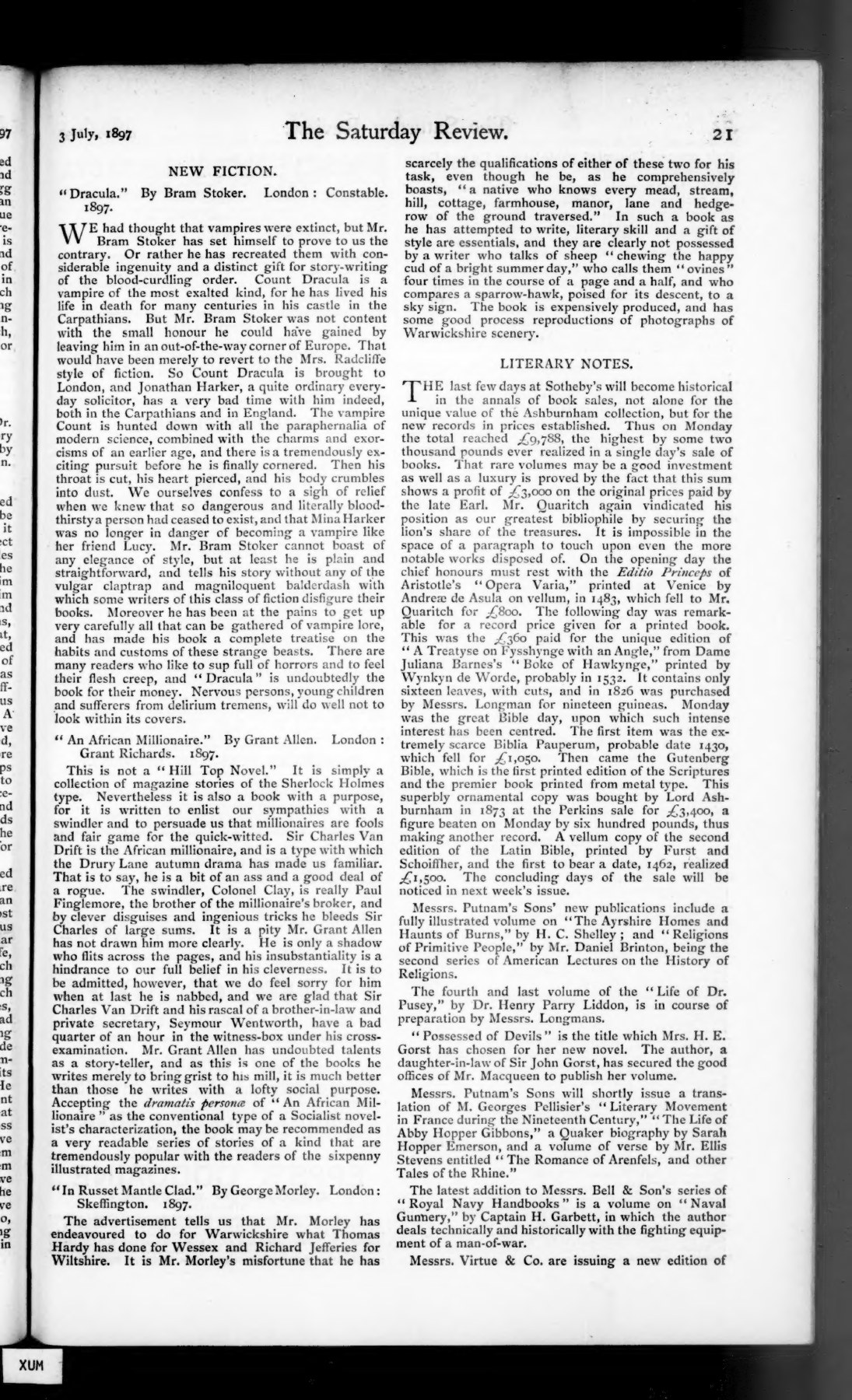
We had thought that vampires were extinct, but Mr. Bram Stoker has set himself to prove to us the contrary. Or rather he has recreated them with considerable ingenuity and a distinct gift for story-writing of the blood-curdling order. Count Dracula is a vampire of the most exalted kind, for he has lived his life in death for many centuries in his castle in the Carpathians. But Mr. Bram Stoker was not content with the small honour he could have gained by leaving him in an out-of-the-way corner of Europe. That would have been merely to revert to the Mrs. Radcliffe style of fiction. So Count Dracula is brought to London, and Jonathan Harker, a quite ordinary every-day solicitor, has a very bad time with him indeed, both in the Carpathians and in England. The vampire Count is hunted down with all the paraphernalia of modern science, combined with the charms and exorcisms of an earlier age, and there is a tremendously exciting pursuit before he is finally cornered. Then his throat is cut, his heart pierced, and his body crumbles into dust. We ourselves confess to a sigh of relief when we knew that so dangerous and literally bloodthirsty a person had ceased to exist, and that Mina Harker was no longer in danger of becoming a vampire like her friend Lucy. Mr. Bram Stoker cannot boast of any elegance of style, but at least he is plain and straightforward, and tells his story without any of the vulgar claptrap and magniloquent balderdash with which some writers of this class of fiction disfigure their books. Moreover he has been at the pains to get up very carefully all that can be gathered of vampire lore, and has made his book a complete treatise on the habits and customs of these strange beasts. There are many readers who like to sup full of horrors and to feel their flesh creep, and “Dracula” is undoubtedly the book for their money. Nervous persons, young children and sufferers from delirium tremens, will do well not to look within its covers.
Original periodical scan
Original source
Read the full article on the publisher’s website.
Read the original article ↗Link checked 30 October 2026. Publisher pages open in a new tab.
Saved archive record
The title, date, source details and any Estate summary above are saved on this website, so this record remains available if the publisher’s page changes.
The historical text is reproduced above. See the source note for the edition used and any limits on collation.