Press archive
The Insanity of the Horrible
9 December 1899 · The Wave
Estate summary
This strongly negative review faults Dracula’s excess and lack of artistic restraint, contrasting it with Stevenson’s horror fiction. Yet the critic admits that the novel holds the reader to the end and leaves an unsettling fear at bedtime.
Read the complete historical review
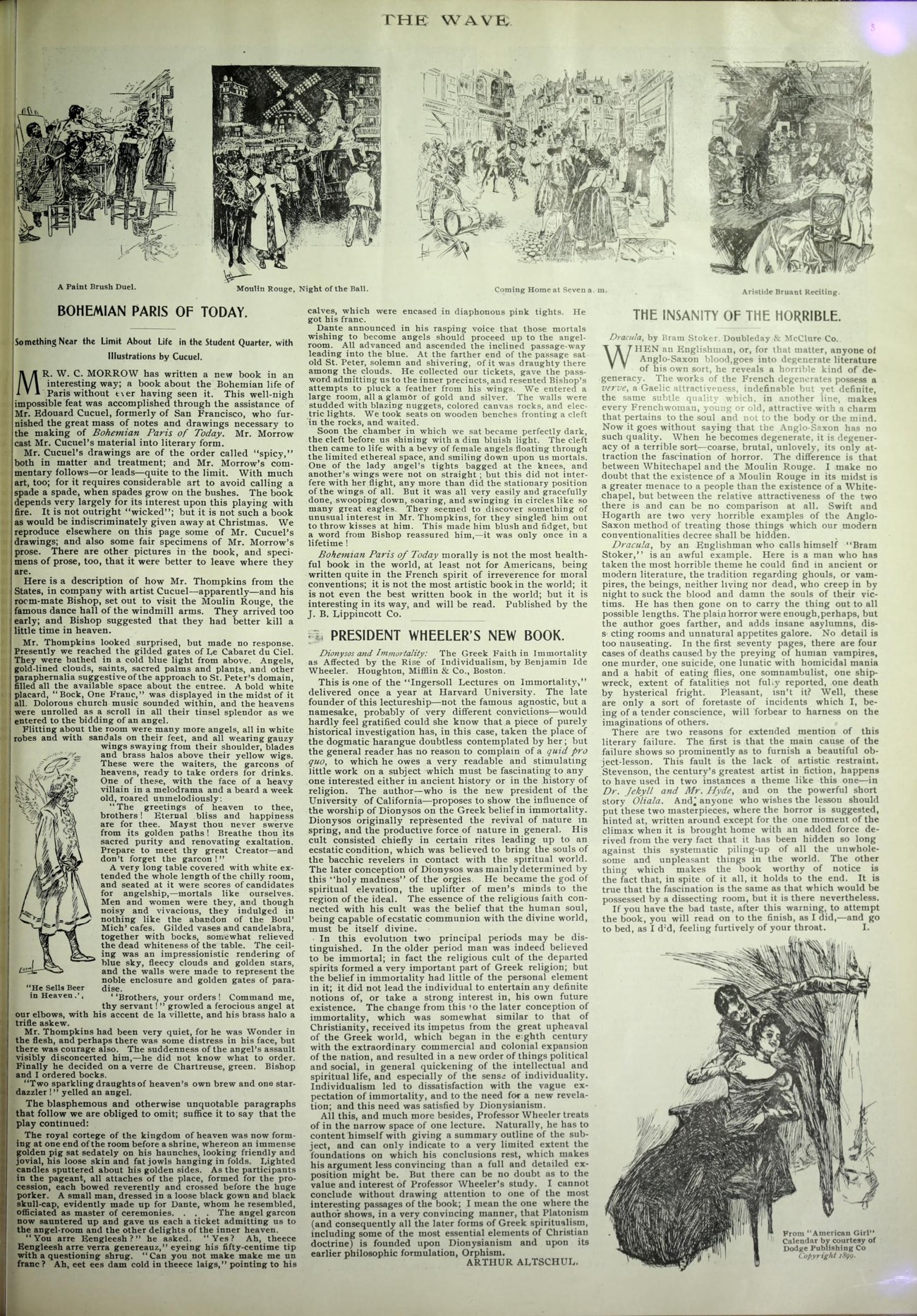
When an Englishman, or, for that matter, anyone of Anglo-Saxon blood, goes into degenerate literature of his own sort, he reveals a horrible kind of degeneracy. The works of the French degenerates possess a verve, a Gaelic attractiveness, indefinable but yet definite, the same subtle quality which, in another line, makes every Frenchwoman, young or old, attractive with a charm that pertains to the soul and not to the body or the mind. Now it goes without saying that the Anglo-Saxon has no such quality. When he becomes degenerate, it is degeneracy of a terrible sort—coarse, brutal, unlovely; its only attraction the fascination of horror. The difference is that between Whitechapel and the Moulin Rouge. I make no doubt that the existence of a Moulin Rouge in its midst is a greater menace to a people than the existence of a Whitechapel, but between the relative attractiveness of the two there can be no comparison at all. Swift and Hogarth are two very horrible examples of the Anglo-Saxon method of treating those things which our modern conventionalities decree shall be hidden.
Dracula, by an Englishman who calls himself “Bram Stoker,” is an awful example. Here is a man who has taken the most horrible theme he could find in ancient or modern literature, the tradition regarding ghouls, or vampires, the beings, neither living nor dead, who creep in by night to suck the blood and damn the souls of their victims. He has then gone on to carry the thing out to all possible lengths. The plain horror were enough, perhaps, but now the author goes farther, and adds insane asylums, dissecting rooms and unnatural appetites galore. No detail is too nauseating. In the first seventy pages, there are four cases of deaths caused by the preying of human vampires, one murder, one suicide, one lunatic with homicidal mania and a habit of eating flies, one somnambulist, one shipwreck, extent of fatalities not fully reported, one death by hysterical fright. Pleasant, isn’t it? Well, these are only a sort of foretaste of incidents which I, being of a tender conscience, will forbear to harness on the imaginations of others.
There are two reasons for extended mention of this literary failure. The first is that the main cause of the failure shows so prominently as to furnish a beautiful object-lesson. This fault is the lack of artistic restraint. Stevenson, the century’s greatest artist in fiction, happens to have used in two instances a theme like this one—in Dr. Jekyll and Mr. Hyde, and on the powerful short story Olalla. And anyone who wishes the lesson should put these two masterpieces, where the horror is suggested, hinted at, written around except for the one moment of the climax when it is brought home with an added force derived from the very fact that it has been hidden so long against this systematic piling-up of all the unwholesome and unpleasant things in the world. The other thing which makes the book worthy of notice is the fact that, in spite of it all, it holds to the end. It is true that the fascination is the same as that which would be possessed by a dissecting room, but it is there nevertheless.
If you have the bad taste, after this warning, to attempt the book, you will read on to the finish, as I did,—and go to bed, as I d’d [sic], feeling furtively of your throat.
I.
Original periodical scan
Original source
Read the full article on the publisher’s website.
Read the original article ↗Link checked 30 October 2026. Publisher pages open in a new tab.
Saved archive record
The title, date, source details and any Estate summary above are saved on this website, so this record remains available if the publisher’s page changes.
The historical text is reproduced above. See the source note for the edition used and any limits on collation.