resources
Remembering Noel Stoker
Irving Noel Thornley Stoker was the only child of Bram and Florence Stoker. In the family, he was always called Noel Thornley Stoker, or NTS. He was called Noel because he was born at Christmas, on 30 December 1879. In this account, his grandson Richard Noel remembers both Noel and his wife, Neelie.
By Richard Noel · 1 May 2020
Bram Florence and Henry Irving
Although Bram was often away, I believe he had considerable influence on his son, the only child of two busy parents. Bram worked incredibly hard for a difficult and demanding man, Henry Irving. He organised eight tours of the Lyceum Company to the United States, with their costumes and sets, arranging Atlantic crossings, hotels and trains and writing by hand up to fifty letters a day. Each tour lasted up to six months. Some took place during his son’s teenage years; added to NTS’s time at boarding school, these absences must have made Bram a remote figure.
Florence accompanied one of the American tours, but generally remained in London, where she had a busy social life. Perhaps her relationship with her son was exemplified by the Punch cartoon “A Filial Reproof”, published on 11 September 1886. It shows Florence, Bram and their son Noel, as they have always been identified in our family. When his mother tells him that little boys should be seen and not heard, Noel replies, “Yes, Mamma! But you don’t look at me!” We still have a framed copy in the family.
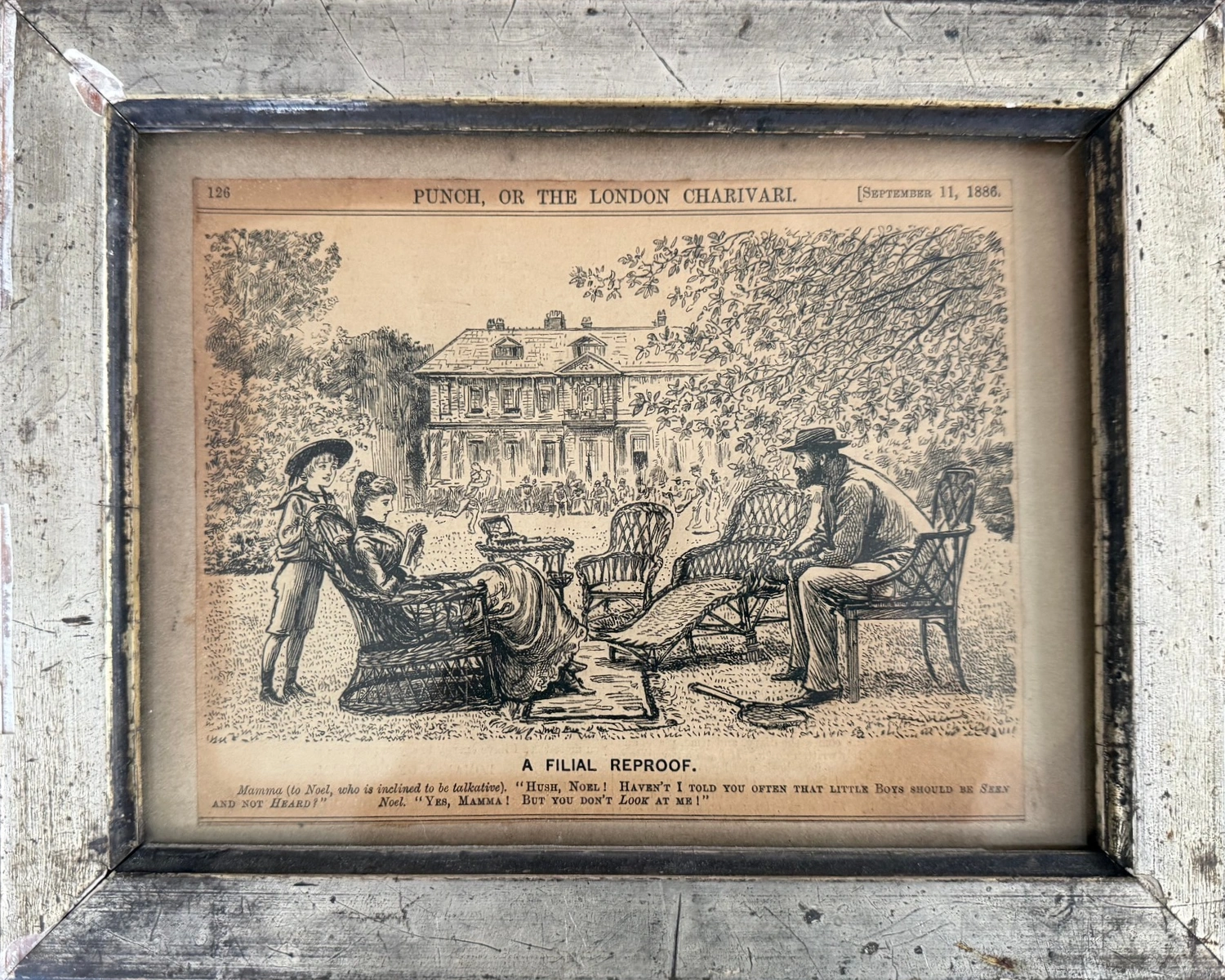
View the original archive scan and source details.
The editor of Punch at the time was Francis Cowley Burnand, whom Bram knew well. In Personal Reminiscences of Henry Irving, Bram recalls a dinner for Henry Morton Stanley at the Garrick Club on 22 October 1882, attended by both Burnand and himself. Describing Burnand and Edmund Yates, Bram writes, “I knew both men well”.
Bram’s account of the Stanley dinner, volume II, pp. 232–233.
As a small child, NTS had a French governess. He consequently spoke and read French fluently and enjoyed French novels throughout his life. He seems to have been fond of her. I believe Florence and NTS resented Irving’s demands on their husband and father, and that this was why NTS dropped ‘Irving’ as his first Christian name.
Education and the Skinners
When Bram came from Dublin to London to work for Henry Irving in 1878, having recently married Florence, he was new to London and English society. His theatre contacts nevertheless helped him send his son Noel to the ‘right’ schools: Summer Fields Preparatory School and Winchester College, founded in 1382. NTS then went to New College, Oxford, founded by William of Wykeham, who had also founded Winchester.
NTS paid for all Jamie’s and my private education, including Winchester, where we were in his old house. I think this gave him a great deal of pleasure, particularly as we both played Winchester College football, as he had nearly sixty years earlier. I always said I was educated thanks to Dracula.
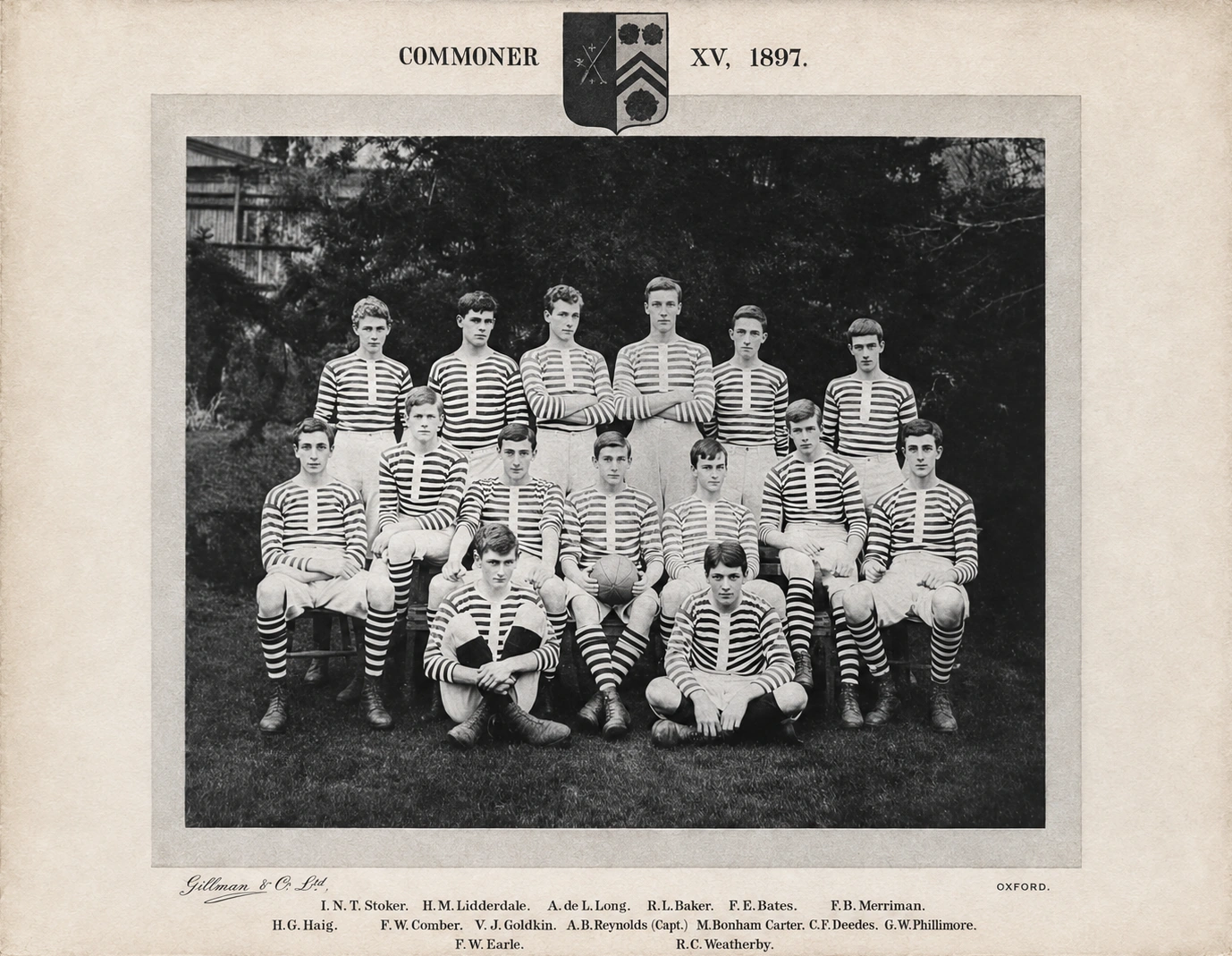
Bram’s contacts also enabled him to arrange for NTS to become an apprentice to the Skinners’ Company, where he enjoyed dining for fifty years. The Skinners were originally furriers. Founded in 1327, their Company is one of the Great Twelve Livery Companies of the City of London. Jamie and I both became Skinners, and I was Master in 1989–90. I think Bram was aware that he was neglecting his son and tried to compensate by arranging a first-class education and membership of the Company.
An accountancy career
Following the Lyceum’s financial difficulties, Bram’s income fell. NTS did not want to be a financial burden, so he left Oxford and became articled to a firm of chartered accountants. After qualifying, he became a partner in Williams Stoker & Co., whose office was at 9 Bedford Row, Holborn.
The firm flourished under NTS, acquiring clients including Hoover, investment companies belonging to Isaac Singer’s descendants, and Royce, of Rolls-Royce. He had his own style: he set prospective articled clerks an ‘exam’ based on questions from The Wrong Box, by Robert Louis Stevenson and Lloyd Osbourne.
Our grandparents
My grandparents married in 1910 and remained happily married for fifty years. Their only child, Ann, my mother, was born in 1916. She married my father, a Royal Naval pilot, in 1936. I was born in 1937, followed a year later by my brother Jamie.
Our father was killed in a flying accident in 1939, while practising torpedo runs at night from an aircraft carrier in the Mediterranean. Our mother became a widow at twenty-two, with two young children. I do not know the details, but from then on our grandparents effectively took responsibility for Jamie’s and my upbringing and education, with enormous generosity and affection. Our mother remarried and had another son, Robin, our half-brother, but that marriage did not last.
Railway tickets and naval history
Perhaps because of his parents’ busy lives, NTS became happy and content in his own company, with his books and hobbies. The hobby I remember best was collecting used railway tickets. These were printed on small cards, with the outward and return journeys on the same card; the outward half would be torn off, leaving the return half. He repaired the half he had collected with a blank, using a predecessor of Sellotape, then stored the ticket in custom-made cabinets.
He acquired used tickets and stubs by befriending the ticket collectors. I never heard his ‘chat-up’ lines, but I imagine they were taken by his old-world charm and his behaviour as a perfect Edwardian gentleman. He was interested in railways and in using timetables to plan journeys.
Another solitary hobby, which I think he pursued between the wars, was researching naval history through ships’ logs at the Records Office. I know little more than that he typed up his findings and kept them in loose-leaf files.
A wartime childhood in Seaview
During the war of 1939–45, our grandmother Neelie cared for Jamie and me in Seaview on the Isle of Wight, where my wife Susan and I were living when I wrote these recollections in 2020. She was helped by a local sixteen-year-old girl who was waiting to train as a nurse.
We slept in a Morrison shelter, an indoor air-raid shelter, and were untroubled by the German bombers flying overhead towards Portsmouth, Southampton and other targets. We were almost oblivious to the war. NTS had moved his office from London to Haslemere, within easy reach of the Isle of Wight, and came at weekends. Protected by our grandparents, Jamie and I had a blissful war, playing on the beach and often picking up anti-aircraft shrapnel, apparently unaware of any danger.
Books and journeys
He loved reading and collecting books. I have a number of them, some perhaps inherited from his parents: sets of Brontë, Kipling and Stevenson, and fine leather-bound novels by Walter Scott, which he used to read to me when I was about nine.
At around that time, he took me for a week’s holiday to Crianlarich, a Scottish village north of Loch Lomond. We sat up on the overnight train. I think he gave me Bram’s cloak to keep me covered during the journey.
His prodigious reading was not confined to English literature or to French novels. He also enjoyed detective stories by Ngaio Marsh and Margery Allingham, whose ‘gentleman’ detectives were in the tradition of Dorothy L. Sayers’s Lord Peter Wimsey.
Home holidays and later life
After the war, we returned to our grandparents’ house in South Kensington, London. We spent only a short time there before beginning ten years of boarding-school education, with holidays in Seaview. NTS also spent his month-long summer holiday there, though I am hazy about whether he came down at weekends.
He continued going to the office, looking after a number of favourite clients, until he was nearly eighty. By then, Jamie and I had begun our own articles: in my case after two years of military service, while Jamie was deferred and never called up. NTS loved dogs and had a succession of ill-trained Pekingese. I remember his walks around Seaview being planned to avoid meeting certain people.
He had suffered poor health for several years. In 1956, while I was doing my military service in Germany, I was summoned home because he was not expected to live. He survived and eventually died in 1961. He was philosophical, continuing his life calmly and without complaint.
The grandfather I remember
NTS was a gentle, kind and generous man, clearly very fond of Jamie and me and of our father, an ‘action man’ and a good athlete, like Bram. He was tall and slender, with red-tinged hair like his father’s. Because of his love of France and all things French, he used a cummerbund to support his trousers and wore espadrilles as slippers. He always wore a hat and smoked a pipe and French cigarettes.
He read the Daily Telegraph and did its crossword, boycotting The Times because it had published a poor review of Dracula. He seldom talked about his father or Dracula, though there was not then the interest there was by 2020. He never drove a car or watched television. I do not remember him listening to the wireless, although he may have done so during the war.
He and Neelie took on the care of two small boys when they were about sixty and fifty-four respectively, with selfless generosity. Looking back, he seems to me the perfect gentleman, embodying Winchester College’s motto, ‘Manners makyth man’. He would never keep his hat on indoors, and he would always open doors for ladies.