Press archive
Review of Dracula
26 June 1897 · Athenaeum
Estate summary
This sceptical review acknowledges energetic invention and disturbing details but faults the novel’s construction, characterisation and literary subtlety. It finds the opening more promising than what follows.
Read the complete historical review
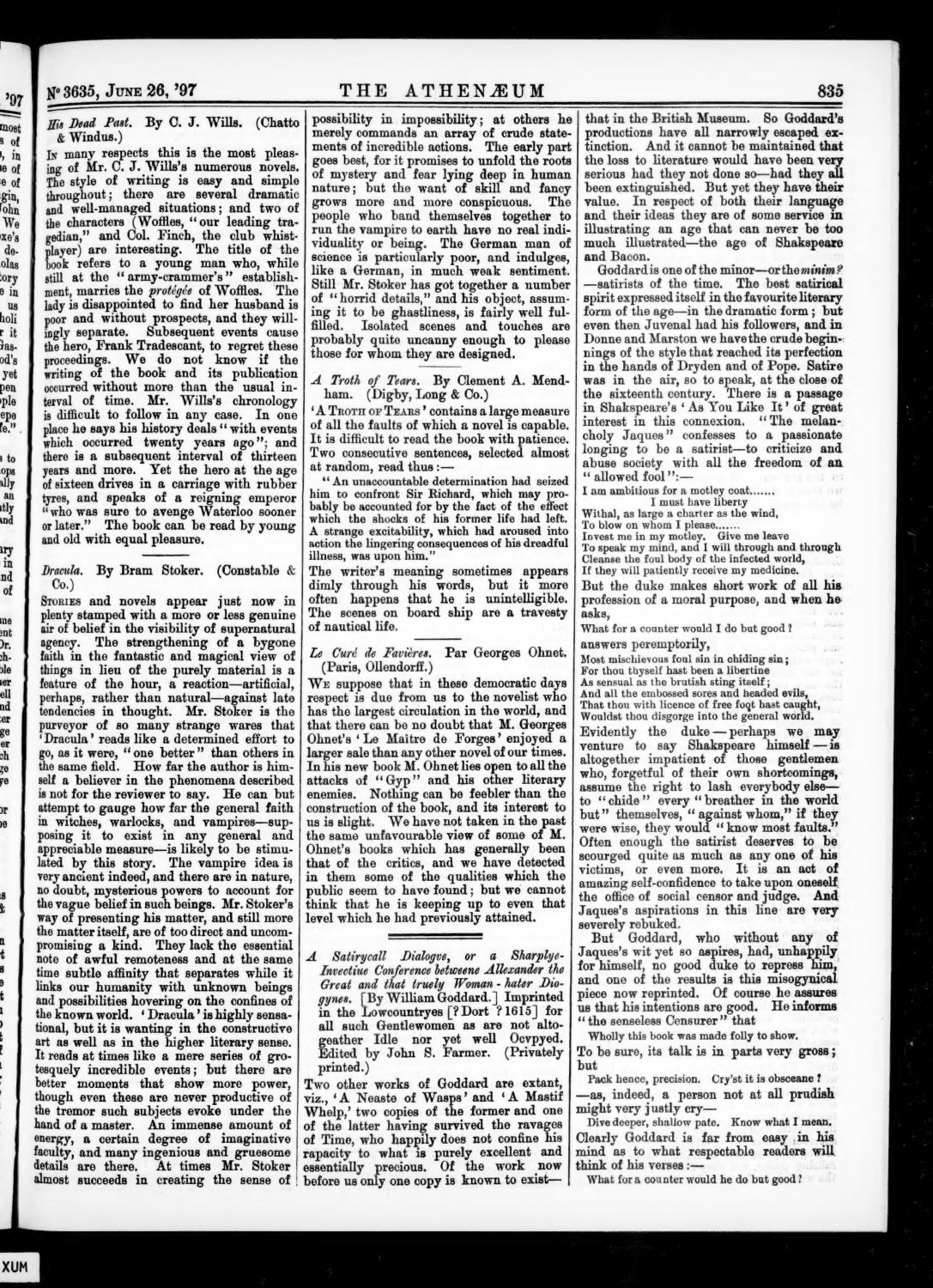
Stories and novels appear just now in plenty stamped with a more or less genuine air of belief in the visibility of supernatural agency. The strengthening of a bygone faith in the fantastic and magical-view of things in lieu of the purely material is a feature of the hour, a reaction—artificial, perhaps, rather than natural—against late tendencies in thought. Mr. Stoker is a purveyor of so many strange wares that ‘Dracula’ reads like a determined effort to go, as it were, “one better” than others in the same field. How far the author is himself a believer in the phenomena described is not for the reviewer to say. He can but attempt to gauge how far the general faith in witches, warlocks and vampires—supposing it to exist in any general and appreciable measure—is likely to be stimulated by this story. The vampire idea is very ancient indeed, and there are in nature, no doubt, mysterious powers to account for the vague belief in such beings. Mr. Stoker’s way of presenting his matter, and still more the matter itself, are of too direct and uncompromising a kind. They lack the essential note of awful remoteness and at the same time subtle affinity that separates while it links our humanity with unknown beings and possibilities hovering on the confines of the known world. ‘Dracula’ is highly sensational, but it is wanting in the constructive art as well as in the higher literary sense. It reads at times like a mere series of grotesquely incredible events; but there are better moments that show more power, though even these are never productive of the tremor such subjects evoke under the hand of a master. An immense amount of energy, a certain degree of imaginative faculty, and many ingenious and gruesome details are there. At times Mr. Stoker almost succeeds in creating the sense of possibility in impossibility; at others he merely commands an array of crude statements of incredible actions. The early part goes best, for it promises to unfold the roots of mystery and fear lying deep in human nature; but the want of skill and fancy grows more and more conspicuous. The people who band themselves together to run the vampire to earth have no real individuality or being. The German man of science is particularly poor, and indulges, like a German, in much weak sentiment. Still, Mr. Stoker has got together a number of “horrid details,” and his object, assuming it to be ghastliness, is fairly well fulfilled. Isolated scenes and touches are probably quite uncanny enough to please those for whom they are designed.
Original periodical scan
Original source
Read the full article on the publisher’s website.
Read the original article ↗Link checked 30 October 2026. Publisher pages open in a new tab.
Saved archive record
The title, date, source details and any Estate summary above are saved on this website, so this record remains available if the publisher’s page changes.
The historical text is reproduced above. See the source note for the edition used and any limits on collation.