Bloxam describes the house
Dracula, Chapter 20
“It was only a few doors from a big white church or somethink of the kind, not long built.”
“It’s a ’igh ’un with a stone front with a bow on it, an’ ’igh steps up to the door.”
 Official Estate
resources
Nobody knows exactly which London house Bram had in mind for Count Dracula. The novel gives the address as facing Green Park at “No. 347, Piccadilly”, a number that does not correspond to a real house. Several buildings facing Green Park have been proposed instead. No. 138 has the best-known attribution; Nos. 107 and 128 offer other possibilities. Each has something in its favour, but no document yet examined shows Bram choosing any of them.
As with Castle Dracula, it helps to separate two questions: where does the story put the house, and where might Bram have found its appearance? He could have borrowed details from more than one building. We present the different arguments below without treating a proposed identification as a settled fact.
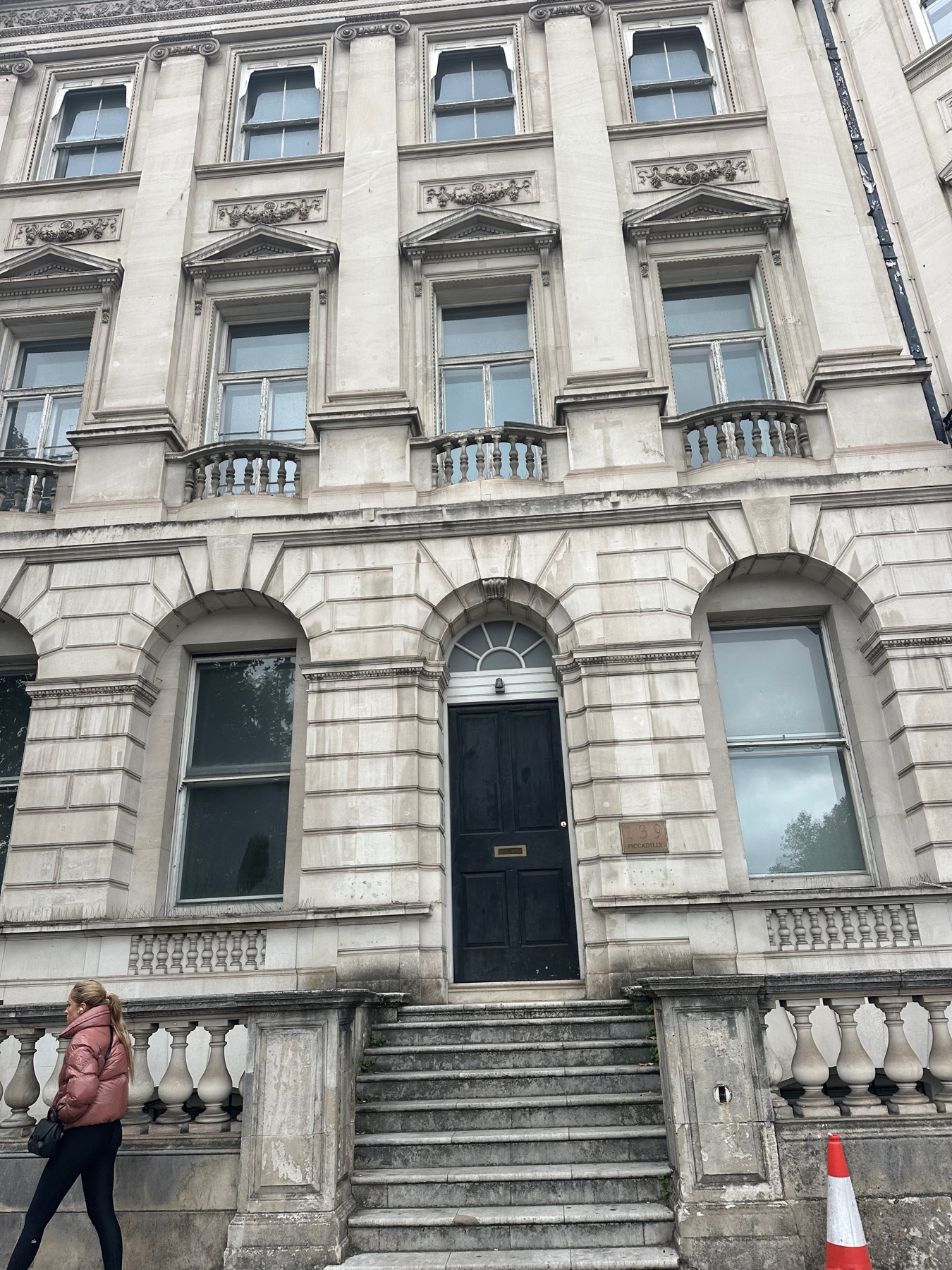
In Chapter 20, Jonathan Harker follows the trail of nine boxes of earth brought from Carfax to Piccadilly. The carter, Sam Bloxam, remembers a tall house with a stone front, a bow and high steps. Harker gets out of his cab at Piccadilly Circus, walks west and finds the house beyond the Junior Constitutional Club. Dusty windows, closed shutters and the remains of a sale board make it look long unoccupied.
The estate agents Mitchell, Sons & Candy tell him that the executors of Archibald Winter-Suffield sold the mansion to Count de Ville, who paid in banknotes. On 3 October the hunters enter it and find eight of the nine boxes. Dracula returns, escapes through the back and reaches the mews. The address belongs to the fiction; the surrounding streets are real.
Dracula, Chapter 20
“It was only a few doors from a big white church or somethink of the kind, not long built.”
“It’s a ’igh ’un with a stone front with a bow on it, an’ ’igh steps up to the door.”
Dracula, Chapter 20
“At Piccadilly Circus I discharged my cab, and walked westward; beyond the Junior Constitutional I came across the house described.”
The balcony, entrance steps and railings add clues. So does the back of the building: a dining room behind the hall, a lower flagged area, steps, a stable opposite and a way out into the mews. That complete escape route may be a better test than a bow window alone.
The Rosenbach holds the working notes under reference EL3 .S874d MS. They were published in Robert Eighteen-Bisang and Elizabeth Miller’s Bram Stoker’s Notes for Dracula: A Facsimile Edition (2008). The editors’ transcription must be distinguished from Bram’s handwritten sheets and from their explanatory footnotes.
The publisher-authorised Google Books search preview shows a passage on p. 111 planning Harker and his companions’ visit to the house in Piccadilly, followed by the search for the Count on 3 October. This confirms the location in the developing plot. No street number is visible in that excerpt.
No street number has been identified in the notes examined so far.
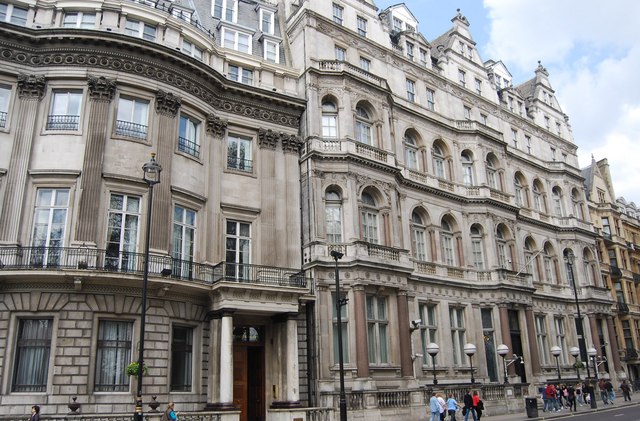
The Junior Constitutional Club stood at 101–104 Piccadilly. Its new building, dating from 1890, had a pale marble and Portland-stone frontage. Bloxam’s uncertain “church or somethink of the kind” could describe it. If so, his “few doors” would favour a house close by. This is an interpretation, however: Bram never says the church and the club are the same building.
That qualification matters. Harker’s word “beyond” tells us which way he went, but does not say how far. No. 138 is much further west than No. 107. Its distance is a stronger objection if the supposed church really is the club.
The identification of No. 138 is attributed in later accounts to Bernard Davies, co-founder of the Dracula Society. The house faces Green Park and has several features readers recognise from the novel: a stone front, projecting bay and first-floor iron balcony. Historic England records that it was remodelled and refaced in 1891. These are real architectural correspondences, although they do not establish Bram’s intention.
The strength of this reading is the combination of visible features and an established history of attribution. Its difficulties are the distance from the club and the unverified entrance and escape route. Descriptions of the older Queensberry mansion must also be kept separate from the building as it appeared after the 1891 alterations.
Leslie S. Klinger reports the attribution to Bernard Davies in The New Annotated Dracula (2008), p. 379, note 38.
No. 107 is much closer to the Junior Constitutional Club. The Savile Club’s own history confirms that it occupied the house from the early 1880s until 1927. A reader’s comment on Exploring London proposes it as the model, chiefly because of that proximity. A later description in London: An Intimate Picture mentions a yellow exterior and bay window.
The Rothschild Archive records the house’s ownership by the Rothschild family and its passage through Hannah de Rothschild to the Rosebery family. Those facts help establish its history, but a resemblance between the fictional owner’s name and Lord Rosebery’s does not establish a deliberate allusion.
The occupied club differs from Bram’s apparently empty mansion, though he could have borrowed its appearance. A Donald Insall Associates heritage assessment (July 2025) identifies the club beside the unfinished Park Lane Hotel in a 1921 London Metropolitan Archives photograph (plate 2). It records the hotel’s acquisition of the club site in 1929 and its replacement by an extension. The report provides a dated visual lead, not a verified 1890s plan of the entrance or rear escape route.
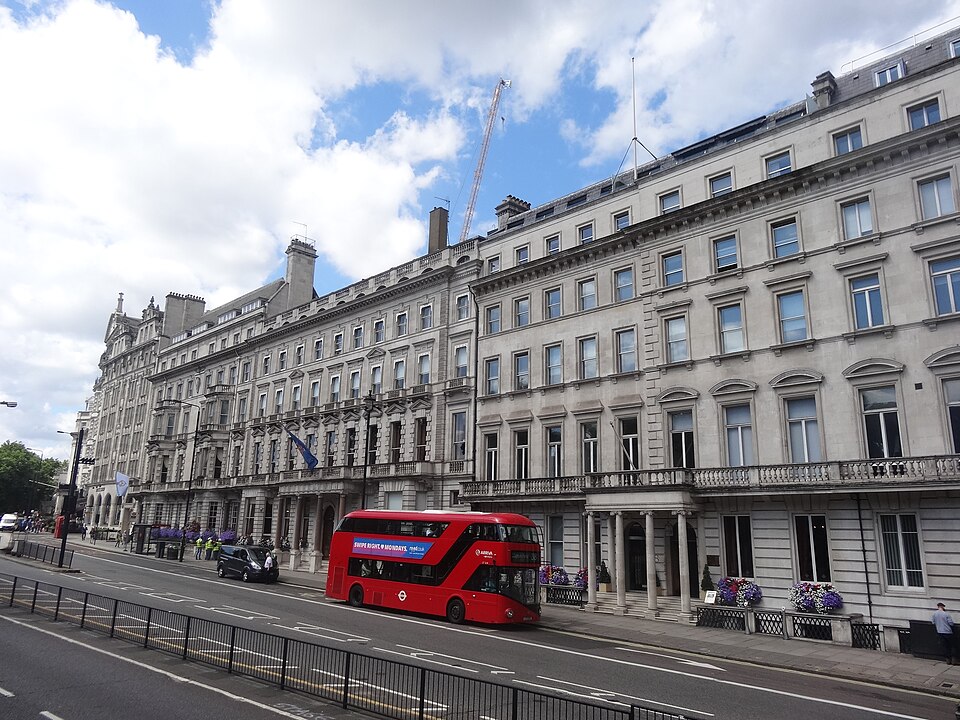
Lester Hillman, writing for the Friends of the Intelligence Corps Museum, tentatively suggests No. 128, now the RAF Club. Its stone frontage and projecting bays make it worth comparing. Historic England dates the work to 1888 and says the building, together with the western part of No. 127, originally formed three private mansions. Today’s address should therefore not be treated as one unchanged Victorian house.
The RAF Club’s history records the acquisition of No. 128 and separate premises at No. 6 Park Lane containing livery yards and carriage stables. This establishes nearby stabling, but not the exact connection Bram describes. A 1919 photograph in the Historic England Archive, reference BL24625, offers a useful earlier view of the entrance and frontage.
This reading needs a more precise match between an original mansion and its rear access. It is a possibility to investigate, not evidence that Bram selected the RAF Club building.
138 Piccadilly: the National Gallery’s catalogue, in its account of Ernest William Beckett, records that his wife Luie died at the family home here in 1891, shortly after their son Ralph’s birth. This supplies a named household during Dracula’s development. It does not establish continuous occupation through 1897, or a connection between that household and Bram’s fictional owner.
139 Piccadilly: the 1912 Dictionary of National Biography dates Algernon Borthwick’s move here to 1884. Arthur H. Beavan’s Tube, Train, Tram and Car (1903) still identifies it as Lord Glenesk’s house. Historic England records the 1891 refacing of No. 139 alongside No. 138. The neighbouring houses must therefore be distinguished, even where older accounts discuss the former Queensberry property as a whole.
128 Piccadilly: the 1888 building history and later club use are established, but a verified 1890s directory or rate-book entry naming the occupants of each original mansion has not yet been located. Later club histories cannot by themselves fill that gap.
Renumbering: Wheatley and Cunningham’s London Past and Present (1891) explicitly relates Byron’s former “13 Piccadilly Terrace” to No. 139 Piccadilly and says the separate terrace names had disappeared. This demonstrates an earlier change at the west end. It does not date the change precisely, demonstrate a further renumbering during the 1890s, or explain the novel’s 347.
A great-great-grandson of Bram Stoker has suggested a way the number 347 could have been made to disguise 138. Each digit of 138 moves by a small step:
| Digit | actual | Shift | disguised |
|---|---|---|---|
| Hundreds | 1 | up 2 | 3 |
| Tens | 3 | up 1 | 4 |
| Units | 8 | down 1 | 7 |
Up 2, up 1 and down 1 would be a simple way of changing a number.
The idea fits what is known of Stoker, who studied mathematics at Trinity College Dublin, and it would explain why the invented number is not random. It is a family hypothesis, not a documented fact. No letter, note or manuscript found so far says that Stoker disguised the address this way, and any three-digit number can be reached from another by some set of small steps, so the theory is best read as a suggestion that happens to fit 138, not as evidence for it.
The arguments are reported secondhand here. Davies’s own account was not found in a primary source.
There are three distinct possibilities. Bram may have described one particular house while disguising its number. He may have combined the position of one house with the appearance of another. Or he may have invented a convincing Piccadilly mansion from familiar features. The surviving evidence examined so far does not decide between them.
The fictional address is not a reliable measuring tool. Piccadilly uses consecutive numbering along one side and back along the other, rather than a simple odd-and-even division. Historical renumbering must be checked locally and by date; an earlier change elsewhere on the street does not prove that every candidate had a different number in the 1890s.
The novel itself also contains small inconsistencies. The agents’ letter is dated 1 October although Harker’s enquiry is narrated on 2 October. Such a discrepancy does not invalidate all the geographical clues, but it cautions against assuming that every detail is part of an exact code.
The house is not the Count’s first appearance on this street. In Chapter 13, Mina and Jonathan take a bus to Hyde Park Corner and walk along Piccadilly. Near the jeweller’s shop, Jonathan recognises Dracula watching a young woman. Carlo Giuliano’s shop was at 115 Piccadilly; the name appears as “Guiliano’s” in commonly used transcriptions. This is a separate scene from the later discovery of the house.
Van Helsing’s Berkeley Hotel supplies another real-world anchor. The original hotel stood at the corner of Berkeley Street and Piccadilly. The present Berkeley in Knightsbridge is a later location. Our London walk links the candidate houses, the London Library, the jeweller’s former site and the original hotel corner.
We would give most weight to a note or letter in which Bram identifies a building; a dated plan matching the whole escape route; or an early, clearly sourced explanation of the identification. Modern resemblance and interesting neighbours are useful starting points, but weaker evidence of intention.
Research updated 30 October 2026. This account remains open to additional documentary evidence.
Bram Stoker’s Notes for Dracula: a Facsimile Edition – Eighteen-Bisang and Miller, 2008 · Rosenbach catalogues, databases and research guides · The Savile Club: institutional history · 31–49 Brick Street and the Park Lane Hotel – Donald Insall Associates heritage assessment, July 2025 · A Girl at a Window – National Gallery catalogue · Algernon Borthwick – Dictionary of National Biography, 1912 · Tube, Train, Tram and Car – Arthur H. Beavan, 1903 · Piccadilly building record – Historic England, list entry 1265657 · Piccadilly – London Past and Present, 1891, Grub Street Project · 138 Piccadilly – Historic England, list entry 1226815 · 128 Piccadilly – Historic England, list entry 1265671 · 128 Piccadilly in 1919 – Historic England photograph BL24625 · 107 Piccadilly – Rothschild Archive estate history · RAF Club building: institutional history · Dracula’s proposed London address – Exploring London, 2017 · “Dracula’s London: Piccadilly” – Ian Farrington, 2025 · “Dracula’s Best-Kept Secret” – Hans Corneel de Roos, 2018 · The original Berkeley Hotel, June 1897 – Historic England photograph BL14115 · “Chicksanguine”: the 128 Piccadilly interpretation – Friends of the Intelligence Corps Museum