Press archive
Recent Novels
31 July 1897 · The Spectator
Estate summary
The Spectator praises Stoker’s invention and command of vampire traditions but finds the sentiment mawkish. Its reviewer questions the fit between modern recording technology and the medieval methods used to defeat Dracula.
Read the historical review
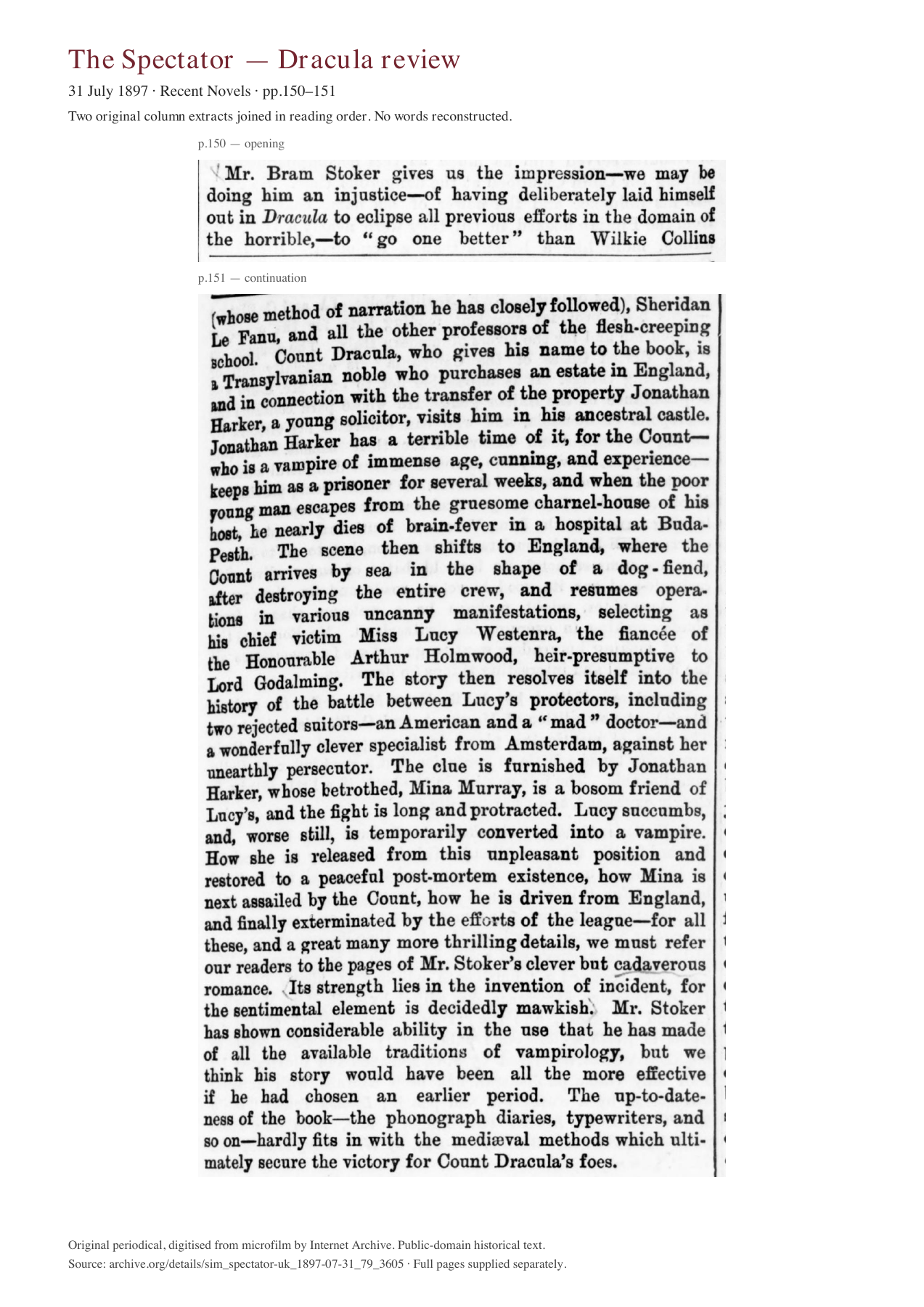
Mr. Bram Stoker gives us the impression—we may be doing him an injustice—of having deliberately laid himself out in Dracula to eclipse all previous efforts in the domain of the horrible,—to “go one better” than Wilkie Collins (whose method of narration he has closely followed), Sheridan Le Fanu, and all the other professors of the flesh-creeping school. Count Dracula, who gives his name to the book, is a Transylvanian noble who purchases an estate in England, and in connection with the transfer of the property Jonathan Harker, a young solicitor, visits him in his ancestral castle. Jonathan Harker has a terrible time of it, for the Count—who is a vampire of immense age, cunning, and experience—keeps him as a prisoner for several weeks, and when the poor young man escapes from the gruesome charnel-house of his host, he nearly dies of brain-fever in a hospital at Buda-Pesth.
The scene then shifts to England, where the Count arrives by sea in the shape of a dog-fiend, after destroying the entire crew, and resumes operations in various uncanny manifestations, selecting as his chief victim Miss Lucy Westenra, the fiancée of the Honourable Arthur Holmwood, heir-presumptive to Lord Godalming. The story then resolves itself into the history of the battle between Lucy’s protectors, including two rejected suitors—an American and a “mad” doctor—and a wonderfully clever specialist from Amsterdam, against her unearthly persecutor. The clue is furnished by Jonathan Harker, whose betrothed, Mina Murray, is a bosom friend of Lucy’s, and the fight is long and protracted. Lucy succumbs, and, worse still, is temporarily converted into a vampire. How she is released from this unpleasant position and restored to a peaceful post-mortem existence, how Mina is next assailed by the Count, how he is driven from England, and finally exterminated by the efforts of the league—for all these, and a great many more thrilling details, we must refer our readers to the pages of Mr. Stoker’s clever but cadaverous romance.
Its strength lies in the invention of incident, for the sentimental element is decidedly mawkish. Mr. Stoker has shown considerable ability in the use that he has made of all the available traditions of vampirology, but we think his story would have been all the more effective if he had chosen an earlier period. The up-to-dateness of the book—the phonograph diaries, typewriters, and so on—hardly fits in with the mediæval methods which ultimately secure the victory for Count Dracula’s foes.
Original periodical scan
Source notes and excerpts
Original source
Read the original historical reproduction. The source note identifies the provider and any remaining qualifications.
Read the original article ↗Link checked 7 November 2026. Publisher pages open in a new tab.
Saved archive record
The title, date, source details and any Estate summary above are saved on this website, so this record remains available if the publisher’s page changes.
The historical text is reproduced above. See the source note for the edition used and any limits on collation.