Press archive
The censorship of fiction – Bram’s original essay
September 1908 · The Nineteenth Century and After
Estate summary
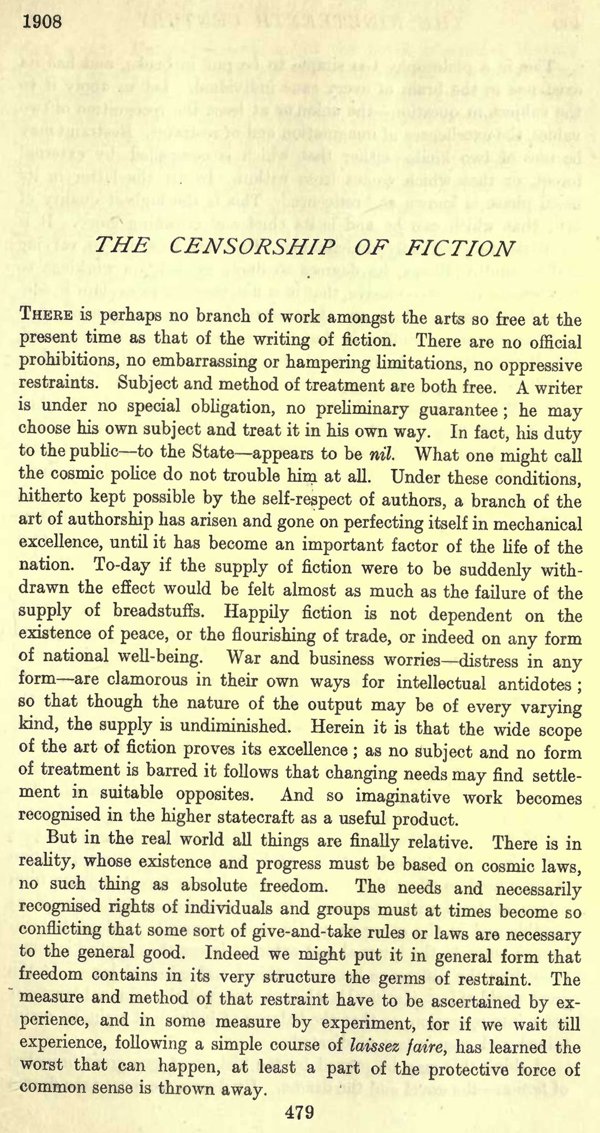
Bram argues that literary freedom depends on writers exercising moral restraint. He treats reticence as a quality of the highest art, then compares the regulation of performed drama with the freedom enjoyed by printed fiction. His argument concentrates on sexual suggestion and what he regards as the commercial exploitation of harmful material, while recognising imagination’s value as a means of teaching. He says that he would prefer another effective remedy to formal censorship, but accepts censorship if authors’ self-restraint and existing protections prove inadequate. This is a controversial statement of Bram’s own position, not the Estate’s endorsement of it. The complete September 1908 essay is reproduced in the nine-page periodical scan below. It can be read alongside the Dominion’s report of R. A. Scott-James’s opposing argument.
Opening paragraph
There is perhaps no branch of work amongst the arts so free at the present time as that of the writing of fiction. There are no official prohibitions, no embarrassing or hampering limitations, no oppressive restraints. Subject and method of treatment are both free. A writer is under no special obligation, no preliminary guarantee; he may choose his own subject and treat it in his own way. In fact, his duty to the public—to the State—appears to be nil. What one might call the cosmic police do not trouble him at all. Under these conditions, hitherto kept possible by the self-respect of authors, a branch of the art of authorship has arisen and gone on perfecting itself in mechanical excellence, until it has become an important factor of the life of the nation. To-day if the supply of fiction were to be suddenly withdrawn the effect would be felt almost as much as the failure of the supply of breadstuffs. Happily fiction is not dependent on the existence of peace, or the flourishing of trade, or indeed on any form of national well-being. War and business worries—distress in any form—are clamorous in their own ways for intellectual antidotes; so that though the nature of the output may be of every varying kind, the supply is undiminished. Herein it is that the wide scope of the art of fiction proves its excellence; as no subject and no form of treatment is barred it follows that changing needs may find settlement in suitable opposites. And so imaginative work becomes recognised in the higher statecraft as a useful product.
Original periodical scan
Original source
Read the original historical reproduction. The source note identifies the provider and any remaining qualifications.
Open the source facsimile at bramstoker.org ↗Link checked 7 November 2026. Publisher pages open in a new tab.
Saved archive record
The title, date, source details and any Estate summary above are saved on this website, so this record remains available if the publisher’s page changes.
The historical text is reproduced above. See the source note for the edition used and any limits on collation.