Press archive
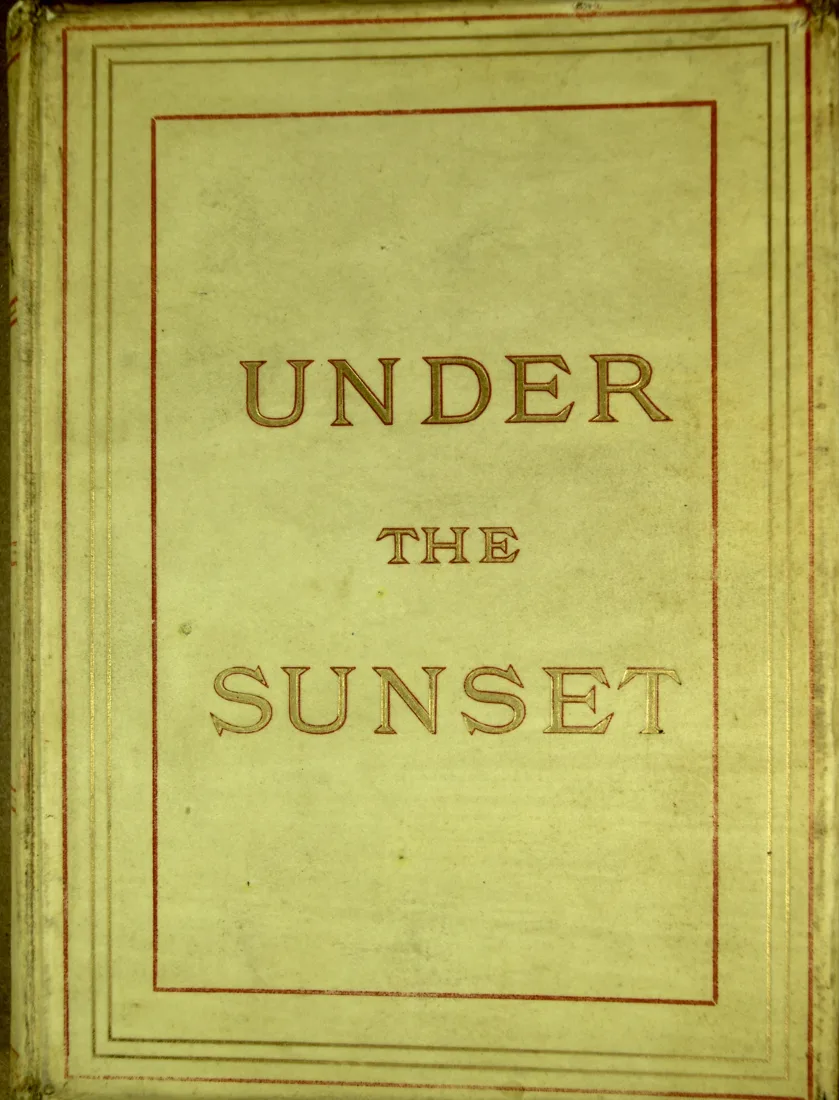
Under the Sunset – a newspaper extract
6 March 1883 · Cromwell Argus
Estate summary
The Cromwell Argus reprints a substantial passage from Under the Sunset under the heading “The Shadow Builder”. A grieving poet crosses the Valley of the Shadow in search of his beloved, finding renewed courage amid desolation when thunder seems to command him onwards. The newspaper attribution identifies Bram and the book, documenting the circulation of his imaginative prose in New Zealand fourteen years before Dracula. The complete newspaper extract is transcribed below and checked against the scanned text. It is not the complete book or a claim that the newspaper heading establishes an otherwise verified story title.
Read the complete newspaper extract
The Valley of the Shadow seemed of endless expanse. Circled by the teeming mist, no eye could pierce to where rose the great mountains between which the Valley lay.
Yet they stood there—Mount Despair on the one hand, and the Hill of Fear upon the other.
Hitherto the poor bewildered brain of the poet had taken no note of all the dangers, and horrors, and pains which surrounded him—save only for the lesson which they taught. But now, lost as he was in the shrouding vapour of the Valley of the Shadow, he could not but think of the terrors of the way. He was surrounded by griesly phantoms that ever and anon arose silent in the mist, and were lost again before he could catch to the full their dread import.
Then there flashed across his soul a terrible thought—
Could it be possible that hither his beloved one had travelled? Had there come to her the pains which shook his own form with agony? Was it indeed necessary that she should have been appalled by all these surrounding horrors?
At the thought of her, his beloved one, suffering such pain and dread, he gave forth one bitter cry that rang through the solitude—that cleft the vapour of the Valley, and echoed in the caverns of the mountains of Despair and Fear.
The wild-cry prolonged with the agony of the poet’s soul rang through the Valley till the shadows that peopled it woke for the moment into life-in-death. They flitted dimly along, now melting away, and anon springing again into life—till all the Valley of the Shadow was for once peopled with quickened ghosts.
Oh, in that hour there was agony to the poor distraught poet’s soul!
But presently there came a calm. When the rush of his first agony passed, the poet knew that to the dead came not the horrors of the journey that he undertook. To the quick alone is the horror of the passage to the castle of the king. With the thought came to him such peace that even there—in the dark Valley of the Shadow—stole soft music that sounded in the desert gloom, like the music of the Spheres.
Then the poor poet remembered what they had told him: that his beloved one had walked through the Valley of the Shadow, that she had known the music of the Spheres, and that she abode in the castle of the king. So he thought, as he was now in the Valley of the Shadow, and has he heard the music of the Spheres, that soon he should see the castle of the king where his beloved one abode. Thus he went on in hope.
But alas! that very hope was a new pain that ere this he wot not of.
Hitherto he had gone on blindly, recking not where he went or what came a-nigh him, so long as he pressed onward on his quest; but now the darkness and the perils of the way had new terrors, for he thought of how they might arrest his course. Such thoughts made the way long indeed, for the moments seemed an age with hoping. Eagerly he sought for the end to come, when, beyond the Valley of the Shadow through which he fared, he could see rising the turrets of the castle of the king.
Despair seemed to grow upon him; and as it grew there rang out, ever louder, the music of the Spheres.
Onward, ever onward, hurried in mad haste the poor distraught Poet. The dim shadows that peopled the mist shrank back as he passed, extending towards him warning hands with long gloomy fingers of deadly cold. In the bitter silence of the moment they seemed to say, “Go back! Go back!”
Louder and louder rang now the music of the Spheres. Faster and faster, in mad, feverish haste rushed the Poet, amid the shrinking shadows of the gloomy valley. The peopling shadows as they faded away before him, seemed to wail in sorrowful warning—“Go back! Go back!”
Still in his ears rang ever the swelling tumult of the music.
Faster and faster he rushed onward, till at last wearied nature gave way, and he fell prone to earth, senseless, bleeding, and alone.
After a time—how long he could not even guess—he awoke from his swoon.
For awhile he could not think where he was, and his scattered senses could not help him.
All was gloom, and cold, and sadness. A solitude reigned around him, more deadly than aught he had ever dreamt of. No breeze was in the air—no movement of a passing cloud. No voice or stir of living thing on earth, or water, or air. No rustle of leaf or sway of branch—all was silent, dead, and deserted. Amid the eternal hills of gloom around lay the valley devoid of aught that lived or grew.
The sweeping mists, with their multitude of peopling shadows, had gone by. The fearsome terrors of the desert even were not there. The poet, as he gazed around him, in his utter loneliness, longed for the sweep of the storm or the roar of the avalanche to break the dread horror of the silent gloom. Then the poet knew that through the Valley of the Shadow he had come; that, seared and maddened though he had been, he had heard the music of the spheres. He thought that now hard by the desolate kingdom of death he trod.
He gazed all around him, fearing lest he should see anywhere the dread castle of the king, where his beloved one abode; and he groaned as the fear of his heart found voice:
“Not here! oh, not here, amid this awful solitude.”
Then amid the silence around, upon distant hills, the words echoed:
“Not here! oh, not here,” till with the echoing and re-echoing rock, the little wilderness was peopled with voices.
Suddenly the echo voices ceased.
From the lurid sky broke the terrible sound of the thunder peal. Along the distant skies it rolled. Far away over the endless ring of the grey horizon it swept—going and returning—pealing, swelling, dying away. It traversed the æther, muttering now in ominous sound as of threats, and anon crashing with the voice of dread command.
In its roar came a sound as of a word:
“Onward.”
To his knees the Poet sank, and welcomed with tears of joy the sound of thunder. It swept away as a power from above the silent desolation of the wilderness. It told him that in and above the Valley of the Shadow rolled the mighty tones of Heaven’s command.
Then the Poet rose to his feet, and with new heart went onwards into the wilderness.
As he went the roll of the thunder died away, and again the silence of desolation reigned alone.
—From Under the Sunset, by Bram Stoker.
Original periodical scan

Original source
Read the original historical reproduction. The source note identifies the provider and any remaining qualifications.
Read the digitised newspaper at Papers Past ↗Link checked 7 November 2026. Publisher pages open in a new tab.
Saved archive record
The title, date, source details and any Estate summary above are saved on this website, so this record remains available if the publisher’s page changes.
The historical text is reproduced above. See the source note for the edition used and any limits on collation.