
resources
Bram’s death certificate – source notes
These reference notes accompany the death certificate on Bram’s biography page. They summarise published interpretations and retain links to the original accounts. These are Estate summaries, not complete copies of the publications. The Estate believes that the evidence is inconclusive.
The wording of the certificate
The family-supplied certified copy gives the cause as “Locomotor Ataxy” followed by “6 months”, then “Granular contracted Kidney. Exhaustion.” This transcription retains the historical spelling Ataxy; it does not silently replace it with the modern form ataxia. The certificate records the death on 20 April 1912 and registration on 22 April. Its wording is a historical record; the differing interpretations below do not establish a modern retrospective diagnosis.
View the original certificate photograph →
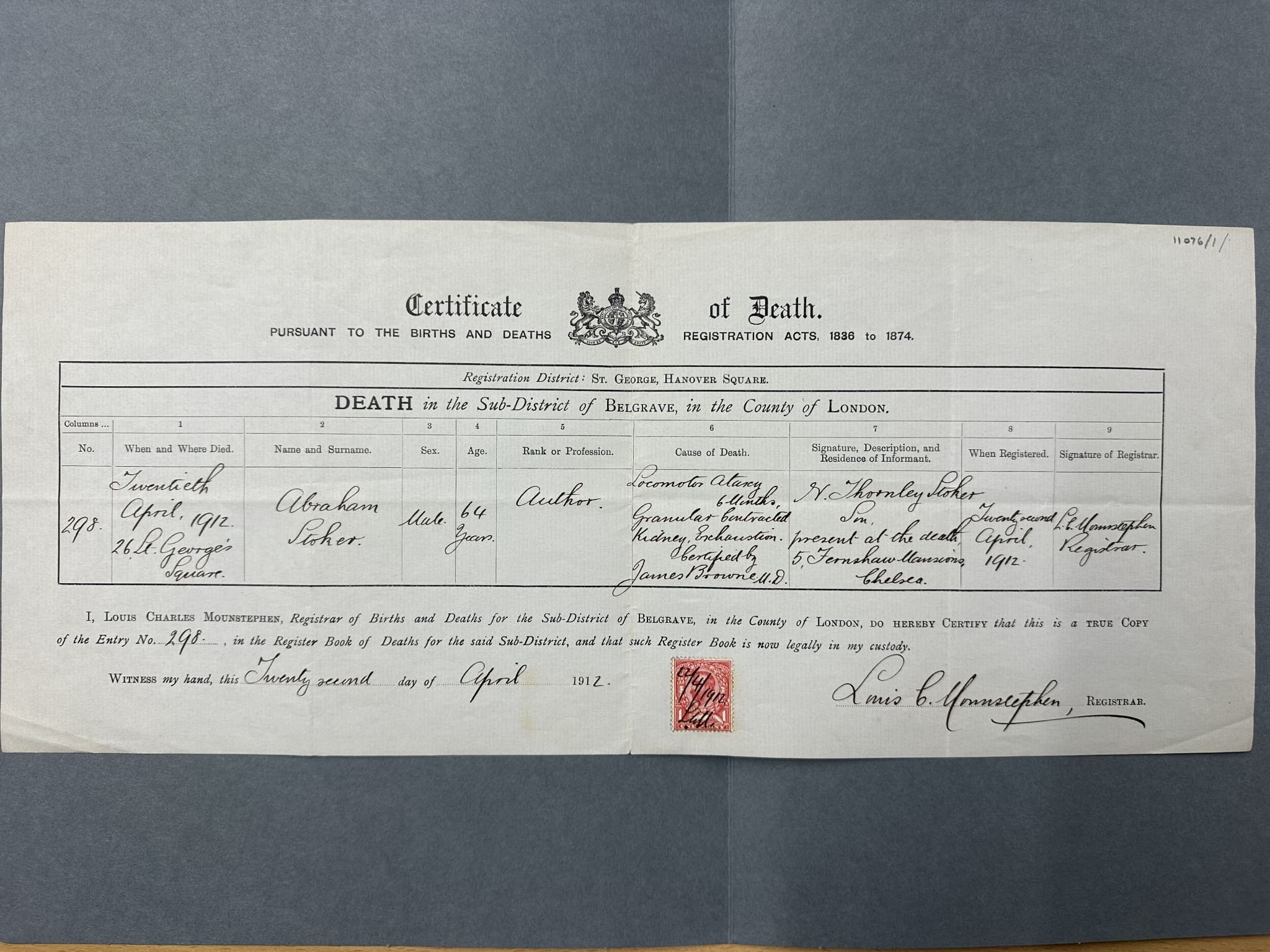
In period usage, “locomotor ataxy” is commonly associated with tabes dorsalis, a condition historically linked to syphilis, and that link is the basis of the debate. “Granular contracted kidney” is an older term associated with chronic kidney disease. The wording is a historical record. The differing interpretations below do not establish a modern retrospective diagnosis.
Where the syphilis claim began: Daniel Farson (1975)
Daniel Farson, Bram’s great-nephew, published The Man Who Wrote Dracula (Michael Joseph, 1975). In it he suggested that “Locomotor Ataxy” was a euphemism for syphilis. His argument drew on the wording of the certificate and on family testimony. Later writers have treated his book as the origin of the claim, and it is the starting point for most later discussion. Farson’s was a biographer’s interpretation, not a medical finding.
An earlier scholarly account: William Hughes (1996)
In the biographical introduction reproduced by Victorian Fiction Research Guides, William Hughes questions how conclusively the death certificate supports the claim of tertiary syphilis. The introduction is signed December 1996 and predates Paul Murray’s 2004 biography, so it documents an earlier scholarly position rather than a response to Murray’s later research. The online transcription contains an apparent error giving the death year as 1911; Bram died on 20 April 1912.
Paul Murray: Dictionary of Irish Biography (2009)
Paul Murray: explaining his research
In an interview with The Wise Owl, Murray explains that he initially expected his research for From the Shadow of Dracula (2004) to disprove the suggestion of syphilis. He says the medical experts he consulted agreed that the evidence indicated that Stoker’s doctor believed he had the disease. Murray says he presented the evidence in his biography and left readers to reach their own conclusions.
A critique of the Farson claim: Dick Collins (2008)
Dick Collins’s “The Devil and Daniel Farson: How Did Bram Stoker Die?” appeared in Journal of Dracula Studies, volume 10, issue 1, article 1 (2008), DOI 10.70013/71z5a6b7. The abstract describes an examination of the certificate alongside other known facts and explicitly presents its conclusions as possibilities rather than a definitive account of his death.
An overview: Roger Luckhurst (2012)
Writing for the Oxford University Press blog on the centenary of Bram’s death (20 April 2012), Roger Luckhurst summarises Farson’s claim and observes that the evidence around Stoker’s life and death remains inconclusive.
Jarlath Killeen: Trinity Writers (2016)
Another family member’s view: Dacre (2018)
Speaking to the New York Post on 6 October 2018, Dacre, Bram’s great-great-nephew, rejected the suggestion that Bram died of syphilis and supplied the newspaper with a copy of the death certificate. This is reported as his own statement and is included for completeness, not as a medical finding.
The linked online accounts were checked on 29 October 2026. Copyright in the original publications remains with their respective rights holders; complete publisher texts have not been copied. Return to Bram’s biography →
Paul Murray: further reading
Source references
Bram Stoker: life and writing – Trinity College Dublin · Bram Stoker research guide – William Hughes · Tabes dorsalis – US National Library of Medicine terminology record · Bram Stoker’s death and later biographical claims – Roger Luckhurst, Oxford University Press · “The Devil and Daniel Farson: How Did Bram Stoker Die?” – Dick Collins, 2008 · Dacre and J. D. Barker on Dracula – New York Post interview, 2018